
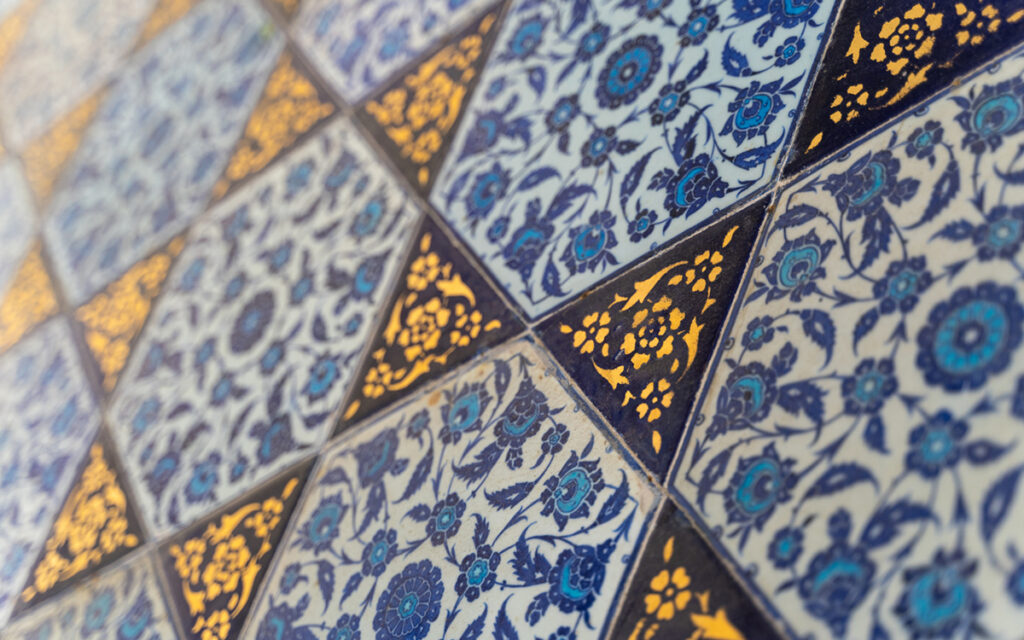

The Unexpected History of Civilization’s Most Enduring Surface
Few building materials have shaped human civilization as quietly or as enduringly as the ceramic tile. At first glance, a tile is simply clay hardened by fire. Yet across more than five thousand years, it has served as a canvas for power, faith, mathematics, commerce, craftsmanship, and public life. Few objects reveal the story of civilization with such surprising clarity.
This article traces the history of both civilization and tile through six extraordinary tiles. We move backward through time: starting under the modern streets of New York to explore the connection with ancient Babylon. Each tile offers a window into its own era, revealing how a simple fired surface came to reflect the ambitions, beliefs, and achievements of the people who made it.
Number 6 – The Subway Tile: Industrial Beauty (1904–Present)
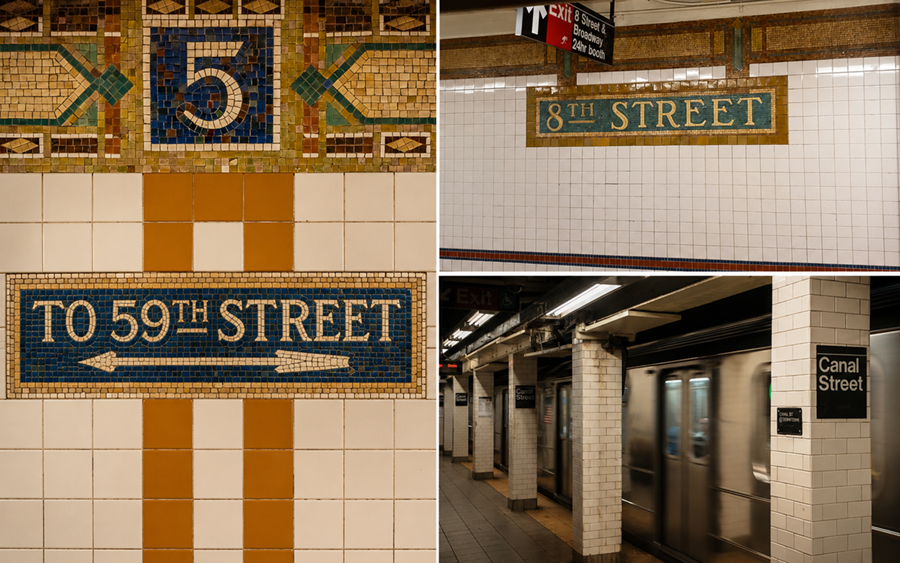
When New York City’s first subway opened in 1904, architects George C. Heins and Christopher Grant La Farge faced an unprecedented challenge: how should a modern public transportation system look?
Their answer reflected the Progressive Era’s faith in sanitation, efficiency, and civic order. Station walls were clad with white glazed ceramic tiles, manufactured primarily by the American Encaustic Tiling Company and other firms specializing in glazed architectural ceramics. Fired at exceptionally high temperatures, the tiles became dense, water-resistant, and remarkably durable, allowing them to withstand decades of heavy public use while retaining their glossy finish. These tiles resisted grime, reflected the glow of the subway’s new electric lighting, and could withstand decades of scrubbing without losing their glossy finish. The now-iconic 3 × 6-inch tile became an emblem of industrial standardization. Machine pressing, uniform firing, and carefully beveled edges allowed thousands of identical units to be installed rapidly while creating subtle shadow lines that animated otherwise plain walls. Decorative faience plaques bearing station names added restrained ornament to a system whose greatest luxury was cleanliness.
In the new century, beauty no longer depended upon elaborate decoration. It emerged from repetition, precision, and quiet confidence in industrial design. The subway wall transformed hygiene into architecture. Yet this seemingly modern invention rested upon centuries of ceramic innovation.
Number 5 – Victorian Tiles: Pattern, Craft, and Industry (1830s–1900)
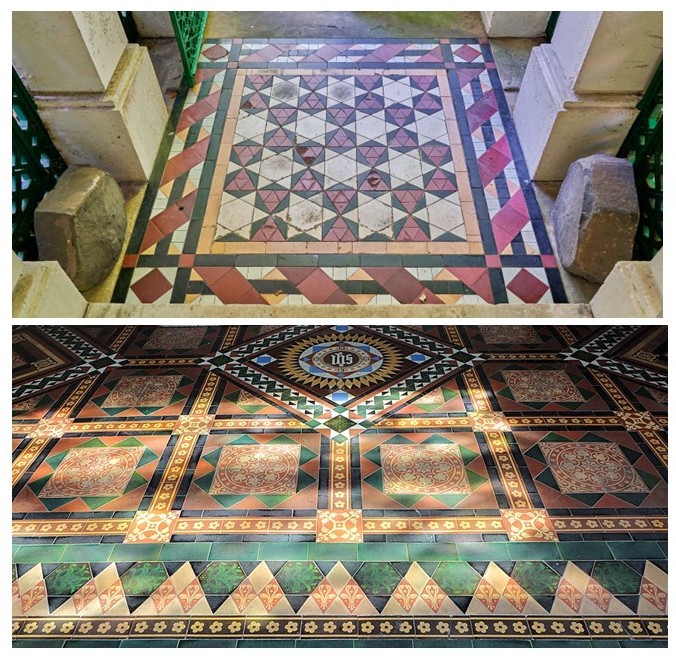
Step inside a nineteenth-century church, railway station, courthouse, or university, and your eyes are often drawn downward.
Victorian encaustic floor tiles transformed architecture into richly patterned carpets of fired clay. Contrary to popular belief, “encaustic” does not refer to painted decoration. Instead, contrasting colored clays were inlaid into carefully carved molds before firing, making the design an integral part of the ceramic body itself. Even generations of foot traffic could wear the surface smooth without erasing the pattern beneath.
The process revived techniques used in medieval English monasteries and cathedrals. Herbert Minton and Minton & Co. perfected new methods of industrial production using hydraulic presses and precision molds, allowing Gothic-inspired floors to be manufactured on an unprecedented scale.
Heraldic shields, quatrefoils, fleur-de-lis, vines, and Gothic tracery decorated churches, museums, civic buildings, and railway stations. Influential designers such as Augustus Welby Northmore Pugin and the critic John Ruskin regarded medieval craftsmanship as an ethical alternative to the excesses of industrial society. Ironically, these nostalgic floors were themselves triumphs of modern manufacturing, proving that industry could reproduce the beauty of the past.
Long before Victorian Britain rediscovered decorative flooring, another ceramic tradition transformed individual tiles into miniature paintings.
Number 4 – Dutch Delft Tile: From Global Trade to Dutch Tradition (Seventeenth Century)
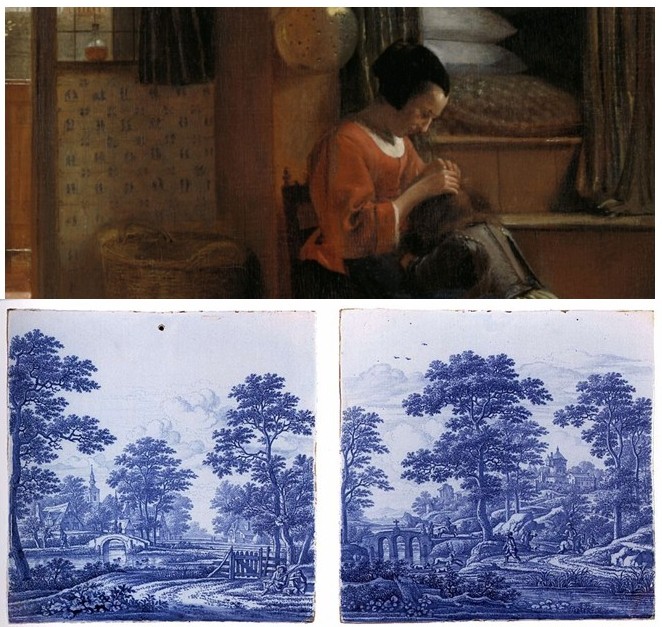
Against brilliant white tin-glazed earthenware, cobalt-blue windmills, sailing ships, biblical stories, children at play, and quiet domestic scenes unfolded with remarkable economy of brushwork.
Although often mistaken for porcelain, Delftware is actually earthenware coated with an opaque tin glaze that created a luminous white surface suitable for painting. Cobalt oxide, applied beneath a transparent lead glaze, softened during firing to produce the fluid blue brushwork that became the hallmark of Dutch ceramics.
Its origins lay in global commerce. During the seventeenth century, the Dutch East India Company imported vast quantities of Chinese blue-and-white porcelain. When political instability disrupted porcelain exports during the transition from the Ming to the Qing dynasty, Dutch potters adapted the fashionable aesthetic using local materials, creating one of Europe’s most influential ceramic traditions.
Individual tiles frequently featured delicate corner ornaments known as ossenkopjes, or “ox-head” motifs, allowing single images to combine into larger decorative wall compositions. The familiar blue-and-white tile was never simply Dutch. It was the product of global trade, artistic adaptation, and technological ingenuity.
Its story, however, reaches even farther east.
Number 3 – Persian Tile: The Golden Age of Islamic Ceramics (Fourteenth–Seventeenth Centuries)
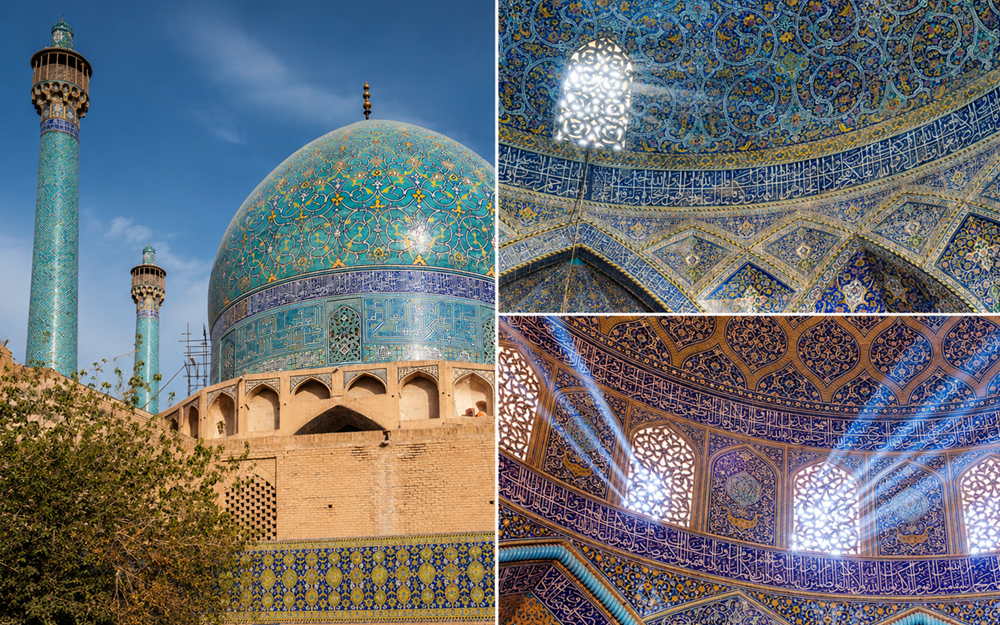
From the Timurid period through the Safavid dynasty, the great mosques and madrasas of Isfahan, Kashan, Yazd, and Tabriz shimmered beneath extraordinary ceramic revetments that dissolved heavy brick architecture into luminous fields of color.
Brick was the principal building material throughout much of Iran, but glazed tile transformed these masonry structures into radiant monuments that reflected light while protecting exterior surfaces from weather. Persian craftsmen mastered sophisticated techniques, including mosaic faience, in which individually cut glazed pieces were assembled like stone mosaics, and later haft-rang, or “seven-color,” tiles, which allowed multiple colors to be painted onto a single tile before firing. The newer process dramatically accelerated construction without sacrificing visual richness.
Scrolling arabesques, stylized flowers, geometric designs, and elegant inscriptions in Kufic and thuluth scripts covered nearly every visible surface. Qur’anic calligraphy functioned simultaneously as sacred text, ornament, and architectural rhythm.
Color carried profound symbolic meaning. Deep cobalt suggested the heavens, turquoise evoked flowing water and paradise, white conveyed purity, and touches of gold recalled divine illumination. As sunlight moved across glazed surfaces, architecture itself seemed to dissolve into light.
These dazzling monuments inspired another remarkable ceramic tradition farther west, where geometry became the primary language of decoration.
Number 2 – Moorish Tile: Masterpieces of Pattern and Symmetry (Thirteenth–Fifteenth Centuries)
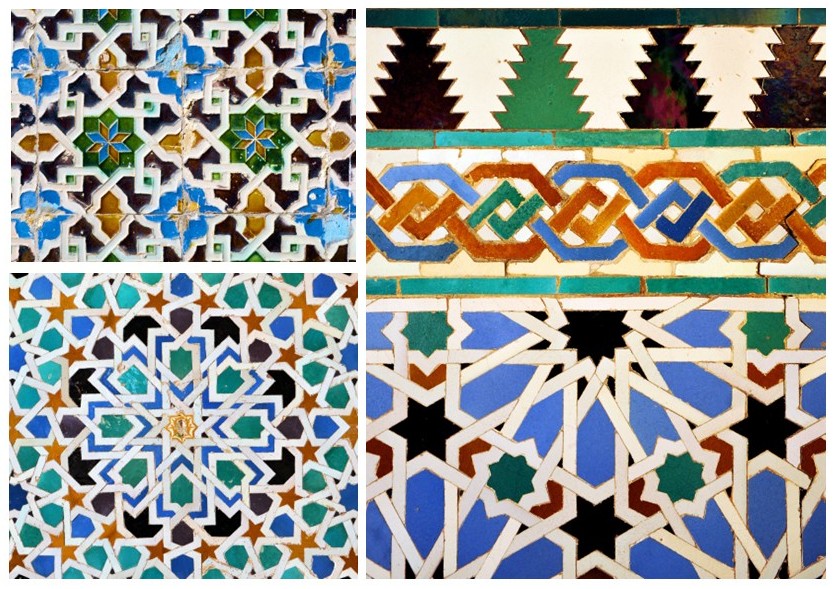
Few artistic traditions demonstrate the relationship between mathematics and beauty more completely than the tilework of al-Andalus and the western Islamic world.
Across the palaces of the Alhambra in Granada, the Alcázar of Seville, and countless mosques and courtyards throughout Islamic Spain and Morocco, intricate geometric compositions unfold with astonishing sophistication. Stars become polygons. Polygons generate interlaced networks. Rotations, reflections, and repeating symmetries create patterns capable of extending indefinitely without losing their underlying order.
Master craftsmen, known as maâlems, shaped hundreds of individually glazed terracotta pieces into precisely cut geometric forms before assembling them by hand into dazzling mosaics known as zellij. Elsewhere, the technique of cuerda seca used fine manganese lines to separate colored glazes during firing, allowing multiple brilliant colors to coexist without blending.
Far from being merely decorative, these designs reflected a sophisticated understanding of proportion, symmetry, and abstraction. In many religious settings, where figural imagery was limited, geometry became a visual expression of unity, infinity, and divine order. Centuries before mathematicians formally analyzed geometric patterns and the principles of symmetry, Moorish artisans transformed geometry into one of history’s most profoundly sophisticated artistic languages.
Their achievement rested upon an even older discovery—that architecture itself could be transformed through brilliant glazed ceramics.
Number 1 – Mesopotamian Glazed Brick: The Origins of Architectural Tile (Sixth Century BCE)
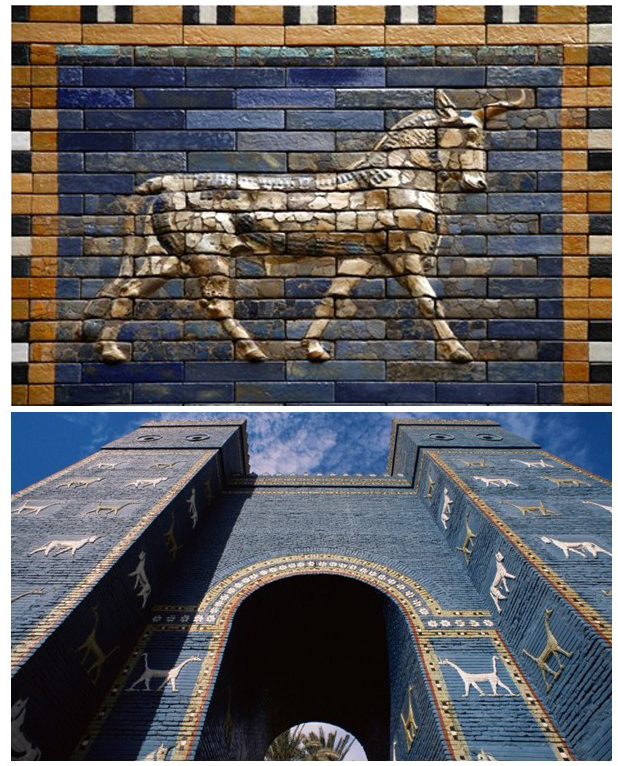
Our journey ends where architectural ceramics first achieved monumental scale.
Around 575 BCE, visitors approaching Babylon encountered one of the ancient world’s greatest spectacles: the Ishtar Gate, commissioned by King Nebuchadnezzar II.
Unlike later ceramic tiles, the gate was constructed from molded glazed bricks, each carefully formed in relief before firing and assembled into an immense architectural composition. Rich blue glazes, colored primarily with copper compounds and enhanced through sophisticated firing techniques, created an unforgettable backdrop for striding lions, powerful aurochs, and the mythical mušḫuššu dragon.
These animals were far more than decoration. The lion represented Ishtar, goddess of love and war; the dragon symbolized Marduk, Babylon’s chief deity; and the aurochs honored Adad, the storm god. Every figure proclaimed both divine protection and imperial authority.
The gate stood at the entrance to Babylon’s Processional Way, transforming political ceremony into theatrical architecture. Long before public transportation systems, Gothic cathedrals, Dutch kitchens, Persian mosques, or Moorish palaces, Mesopotamian craftsmen had already discovered that fired clay and brilliant glaze could turn ordinary walls into symbols of power.
“Every tiled surface reflects the values of the people who made it, revealing what they believed deserved permanence.”
Decoration, then, is never merely decoration. Every tiled surface reflects the values of the people who made it, revealing what they believed deserved permanence. Beneath our feet, along our walls, and across the monuments of long-vanished civilizations, fired clay continues to transform ordinary earth into works of lasting beauty, reminding us that even the most familiar materials can tell the grandest stories of human history.

1 Comment
I have a bunch of pics I took of tile designs in London… subways, museum floors, etc all have ceramic accents. I am dying to figure out a way to use them in paintings!