

Recently, during one of those zombie-like social-media scrolling sessions, I came across an artist discussing what she regarded as the core difference between “Photorealism” and “Academic Realism.” As many people who know me might expect, I stopped to hear what she had to say.
To be fair, I found her larger point thoughtful and useful, particularly regarding the labels artists adopt and the assumptions those labels carry. “Realist,” “Academic,” and “Photorealist” are not neutral or interchangeable terms. Each points toward a different history, set of practices, and understanding of what a representational image is supposed to do. Used carefully, such labels can clarify an artist’s aims and affiliations. Used loosely, they can create distinctions that appear much cleaner than the historical record permits.
The part of her explanation that especially caught my attention was the presentation of photography—or, more precisely, its absence—as a defining criterion of academic realism. That formulation has a certain initial plausibility. The institutions and pedagogical practices associated with European academic art developed long before photographic processes were publicly introduced in 1839. Many influential academic programs emphasized drawing, anatomy, proportion, perspective, the study of antique sculpture and selected earlier masters, work from plaster casts, and study from the living model.
Photorealism, by contrast, emerged as a recognizable tendency during the late 1960s and early 1970s, particularly in the United States, with related developments in Europe. Photographs were not merely incidental references within this work. They commonly served as the principal sources through which subjects were selected, framed, cropped, focused, transferred, enlarged, and translated into paintings. The movement’s pictorial language also frequently preserved characteristics associated with photographic images, including depth-of-field effects, abrupt cropping, reflections, glare, flattened spatial relationships, and the visual contingencies of mechanically recorded scenes.
Seen only in those broad terms, the distinction may appear straightforward: academic practice belongs to a prephotographic tradition centered on drawing and observation, while Photorealism belongs to a modern movement centered on photographic mediation. That apparent clarity, however, begins to break down as soon as the terms are examined more carefully.
Academic training was not founded exclusively on unmediated observation. It included direct study from casts and living models, but it also involved copying prints and drawings, studying earlier artworks, working from inherited conventions, consulting sculpture and textual sources, and constructing compositions from separately gathered information. Its historical priority over photography does not make it equivalent to an exclusively “camera-free” method. Nor do academic art and Photorealism name equivalent kinds of things.
Academic art broadly refers to art substantially shaped by the standards, conventions, theories, and principles of judgment promoted by particular academies or academy-related cultures. Those standards varied among institutions, nations, and periods. Academic art was consequently neither a single fixed style nor a uniform working procedure.
Academic training or academy-based pedagogy refers more specifically to the organized educational practices through which artists developed competencies in drawing, proportion, anatomy, perspective, composition, representation, and related areas. Academic training could influence an artist’s later work without determining every source, instrument, or studio procedure that the artist might employ.
Photorealism, by contrast, denotes a historically situated twentieth-century artistic movement or tendency in which photography was typically fundamental to both the production and the appearance of the work. Its defining relationship to photography cannot be reduced merely to the fact that an artist looked at a photograph. The photograph commonly structured the image at multiple levels, from selection and framing to transfer and final visual effect.
Photography itself is not an artistic movement or school. It is a medium, a technology, and a family of image-making practices. Within painting, a photograph may function as a documentary record, reference source, compositional aid, transfer mechanism, memory supplement, optical study, or conceptual subject.
An artist’s use of a photograph does not, by itself, make that artist a Photorealist any more than painting from a plaster cast automatically makes an artist an academic painter. A photograph may contribute only one fragment of information to an image assembled from models, objects, sketches, written research, memory, imagination, and direct observation. Conversely, an artist may organize an entire painting around the particular spatial, tonal, temporal, and optical properties of a photographic source.
The relevant question is therefore not simply whether a photograph was present. The more useful questions are what role it played, how much authority it exercised over the resulting image, which of its characteristics were retained or transformed, and how it related to the artist’s broader pictorial aims.
The idea of the “camera-free” academic artist is consequently more complicated than it first appears. It may describe the practice of a particular artist, school, exercise, or contemporary atelier, but it should not be projected backward as a universal historical requirement of academic identity. The academic institutions and standards under discussion originated before photography; that does not establish that later academically trained artists were uniformly prohibited from adopting it.
Before deciding whether photographic reference separates academic realism from Photorealism—or whether it disqualifies a work from academic realism altogether—we must first establish what academic art, academic training, academic realism, and Photorealism actually describe in a bit more detail.
What “Academic Realism” Actually Describes
The phrase “academic realism” is common in contemporary atelier and studio discourse, and it also appears in scholarly discussions of art across a variety of national and historical contexts. Its meaning is not uniform. It has been used to describe forms of naturalistic representation associated with European academies, colonial or state art schools, modern institutional systems, and later revivals of academy-derived training. It should therefore not be assumed to refer to a single universally recognized movement, doctrine, style, or studio procedure.
A clear discussion requires distinctions among the academic tradition, art academies, academic training, academic art, academicism or academism, naturalistic representation, and the historically specific nineteenth-century Realist movement.
The Academic Tradition
In this essay, the term “academic tradition” is used as a broad analytical category. It refers to the historically related institutions, theories, pedagogies, professional structures, and standards of artistic judgment associated with European art academies and with later schools or studios that inherited, adapted, or consciously reconstructed parts of those systems.
This tradition included more than instruction in drawing or painting. Academies could function as professional associations, teaching institutions, centers of artistic theory, exhibition authorities, competition administrators, and mechanisms for patronage or official recognition. They also helped distinguish the learned or “liberal” status increasingly claimed for painters, sculptors, and architects from the craft-based status traditionally associated with guild organization (in which training, workshop practice, production, and professional entry were regulated through apprenticeship and trade membership), and contributed to claims that the visual arts belonged among the liberal or intellectual arts. Their functions, authority, and relationship to the state differed by place and period. The academic tradition was therefore neither geographically uniform nor historically fixed. It did not consist of one curriculum transmitted unchanged across Europe. Institutions differed in governance, membership, educational sequence, access to models, theoretical commitments, systems of competition, and relationships with exhibitions and patronage. Even within one institution, priorities could change, and competing theories could coexist.
Important early examples include the Florentine Accademia del Disegno, established in 1563; the Accademia di San Luca in Rome, conventionally dated to 1593, when its founding principles were formally articulated; and the French Académie Royale de Peinture et de Sculpture, founded in 1648. The Roman academy had earlier institutional antecedents and papal support, but 1593 is the date used by the National Gallery of Art’s scholarly project for its foundation as an academy.
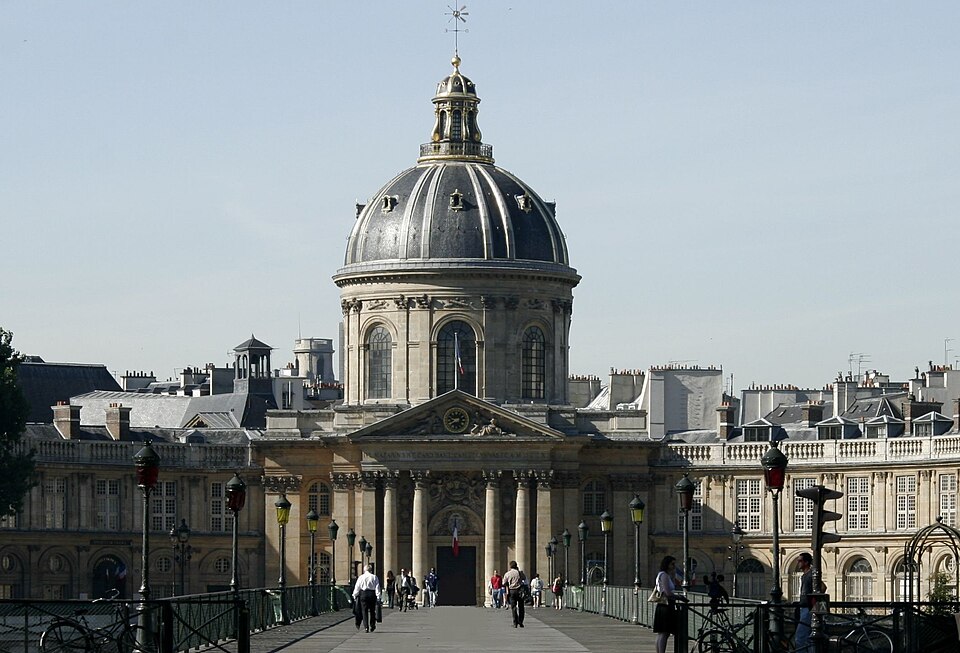
The French Royal Academy was abolished by the National Convention in 1793, amid the revolutionary suppression of royal academies and other institutions associated with the ancien régime. The Académie des Beaux-Arts was established in 1816 within the Institut de France as a new institutional configuration rather than as an uninterrupted continuation of the Royal Academy. These bodies should not be treated as a single, unchanged institution operating under successive names. Nor should the Académie des Beaux-Arts be conflated with the École des Beaux-Arts, although the academy, the school, teaching ateliers, competitions, the Salon, and systems of state patronage formed interconnected parts of French artistic life.
The French system became especially influential internationally during the eighteenth and nineteenth centuries. It should not, however, be treated as a complete model for every academy in Italy, Britain, Germany, Austria, Russia, Spain, Scandinavia, the United States, or elsewhere.
Academic Art
In established art-historical usage, academic art most reliably refers to art that substantially conforms to standards, principles of taste, conventions, or artistic priorities promoted by art academies. The Getty Art & Architecture Thesaurus defines it concisely as art conforming to the official standards and principles of taste of European and American academies. Such a controlled-vocabulary definition is useful, but it requires historical qualification. The standards promoted by academies were neither identical nor static, nor universally enforced. Academic art should therefore not be understood as one perfectly uniform visual style.
Nor should academic art be defined simply as anything produced by an academy member, exhibited at an official Salon, or created by someone who received academic training. Official institutions sometimes admitted works that challenged academic conventions, and academy-trained artists could subsequently adopt Romantic, Realist, Naturalist, Symbolist, or other positions. Institutional participation, educational background, and stylistic conformity overlap, but they are not equivalent categories. The nineteenth-century Salons, for example, included both defenders and critics of prevailing academic expectations.
A work is therefore most defensibly described as academic when it is substantially shaped by the artistic standards, theories, conventions, or systems of judgment associated with a particular academy or academy-related culture.
What Academy-Promoted Standards Included
The phrase “academy-promoted standards” does not refer to a single universal checklist. While this may sometimes be interpreted as the common characteristics attributed to the landscape of academic art (a very refined surface, a favoring of form and draftsmanship over expressive color, and an ‘idealized form of beauty ‘), here it refers to historically variable expectations concerning artistic knowledge, competence, judgment, and professional achievement.
Many influential academies placed considerable importance on some combination of:
- command of drawing, particularly the representation of the human figure;
- knowledge of anatomy, proportion, perspective, and spatial construction;
- study of sculpture from antiquity and selected earlier masters;
- copying prints, drawings, paintings, or plaster casts;
- study from the living model;
- compositional invention and the organization of multiple figures and elements;
- intelligible gesture, expression, narrative action, and decorum;
- technical control appropriate to the medium and intended genre;
- and the capacity to select, organize, clarify, or idealize material drawn from observation.
These emphases were not present in equal measure everywhere. Their sequence, interpretation, and relative importance differed across academies and periods.
The human figure held particular importance in many systems. In nineteenth-century French academic training, mastery of anatomy through study of the living nude was central to preparation for history painting. Restrictions on women’s access to nude models consequently limited their ability to compete within the genres accorded the greatest institutional prestige.
Many academies also recognized a hierarchy of genres. In the influential hierarchy associated with European academic theory, history painting was generally ranked above portraiture, landscape, genre painting, and still life. This hierarchy rested on the belief that history painting demanded learning, imagination, moral or intellectual significance, compositional complexity, and mastery of the human figure. Its subjects could include history, scripture, mythology, allegory, and literature.
These standards were promoted through more than classroom exercises. They could be reinforced through lectures, competitions, prizes, admissions procedures, juries, commissions, exhibitions, critical discourse, and access to professional advancement. They should not, however, be reduced to a preference for polished surfaces, minute detail, classical subjects, or idealized bodies. Those features became prominent in certain forms of academic art, but they were not universal academy-wide requirements. Academic institutions accommodated considerable variation in subject, handling, degree of idealization, and relationship to visible nature. Neither should academy-promoted standards be interpreted as requiring artists to reproduce nature indiscriminately. In many academic theories, artistic achievement involved selection, organization, correction, generalization, or idealization. Observation supplied material, but artistic judgment was expected to determine how that material would function within the work. Academic art was therefore not synonymous with literal visual transcription. It could combine close naturalistic description with idealization, historical reconstruction, rhetorical gesture, inherited conventions, and substantial invention.
Academicism and Academism
The related terms academicism and academism have been used in different ways across languages and art-historical traditions. They may refer descriptively to art, doctrines, conventions, or institutional practices associated with academies.
Unfortunately, they have also frequently carried a critical or pejorative implication in some contexts. In such scenarios, academicism can suggest formulaic production, rigid adherence to inherited models, institutional conservatism, conventionality, or technical proficiency insufficiently accompanied by invention or originality.
The terms should therefore not be treated as completely neutral or universally interchangeable synonyms for academic art. Their meaning depends on the writer, language, period, and national historiography (the study of how history was written). Where either term is used, its intended evaluative force should be clear from context.
Academic Training and Academy-Based Pedagogy
The expression “academic method” can be intelligible in ordinary discussion, but it risks suggesting that the academies possessed a single standardized method of drawing, painting, or picture construction. For greater historical precision, this essay uses the terms “academic training,” “academic pedagogy,” and “academy-based pedagogy” when referring to educational structures.
These terms describe a broad family of organized teaching practices rather than one universal curriculum. Depending on the academy, atelier, period, and student’s level of advancement, instruction could include copying prints or drawings, drawing geometric forms, working from plaster casts, studying perspective and anatomy, copying established works, drawing from the living model, and undertaking exercises in composition and ultimately painting.
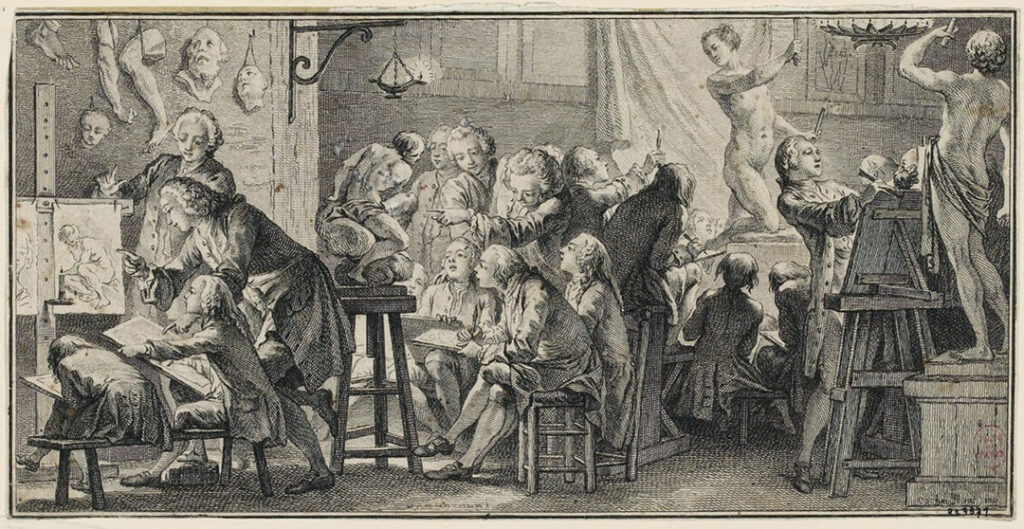
A frequently described progression moved from two-dimensional models to casts and then to the living figure, but this sequence was neither universal nor immutable. In nineteenth-century France, moreover, training was distributed across the École des Beaux-Arts, private or professorial ateliers, museum copying, competitions, and independent study rather than confined to one institution. The capacities cultivated through such training could include draftsmanship, proportional and spatial judgment, anatomical understanding, control of gesture and pose, visual memory, compositional organization, and the ability to construct persuasive representations of bodies, objects, and space.
Academic training had professional and aesthetic consequences, but it did not mechanically determine an artist’s mature work. Artists with academic training participated in Neoclassicism, Romanticism, Realism, Naturalism, Orientalism, Symbolism, portraiture, landscape, illustration, and other forms of production. Academic training must therefore remain distinguishable from academic art. An artist could be academically trained without consistently producing academic art, just as an artist could adopt academic conventions without completing a formal academy curriculum.
Observation, Invention, and Academic Picture-Making
Direct observation occupied an important place in many academic curricula, particularly in cast drawing, life drawing, portraiture, anatomical study, and certain forms of landscape or object study. It was not, however, necessarily the sole source or determining procedure of the finished image. This distinction is especially clear in history painting. A scene from scripture, mythology, literature, allegory, or remote history could not ordinarily be observed as one complete event. Its representation required invention and synthesis.
Depending on the artist and project, a composition might be developed through preliminary sketches, figure studies, drawings from models, drapery studies, anatomical references, architectural research, costumes, studio props, sculpture, prints, earlier artworks, landscape studies, written accounts, memory, and imagination. Individual elements could be observed separately and then revised, idealized, rearranged, or combined within a scene that never existed as a complete configuration before the artist.
Naturalistic appearance should therefore not be confused with the direct transcription of a single intact visual source. The convincing representation of figures, materials, architecture, illumination, and space could result from a highly constructed process.
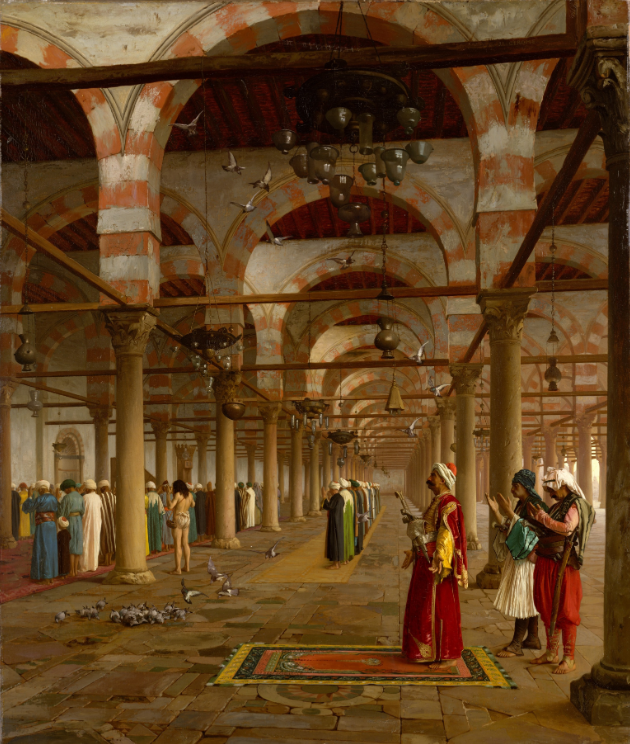
Jean-Léon Gérôme’s Prayer in the Mosque illustrates this distinction. Its precise description creates an impression of documentary authenticity, but the Metropolitan Museum notes that Gérôme combined elements that do not accurately correspond to a single place, time, or custom. The work’s apparent realism is consequently a product of selection and construction rather than an unmediated record of one witnessed event.
Photography and Academic Standards
As I have pointed out earlier, photography was not part of the original formation of European academy-based pedagogy. The principal structures of academic instruction had been established long, long before photographic processes were publicly introduced in 1839. Drawing, copying, cast study, anatomical study, perspective, composition, and work from the living model therefore developed independently of photography. This chronological fact does not support the stronger claim that photography remained outside all academies, ateliers, or academically trained practices after 1839.
Academy-promoted standards generally concerned artistic knowledge, competence, judgment, and pictorial achievement rather than establishing a single academy-wide policy governing all permissible reference technologies. There is no defensible basis for attributing either a universal prohibition or a universal requirement concerning photography to the academic tradition as a whole.
After its introduction, photography was adopted unevenly. It could serve as a reproduction of an artwork, an architectural or archaeological record, an anatomical or motion study, a travel document, a record of costume or pose, or a reference for a particular element of a composition. Its use depended on the institution, teacher, artist, exercise, period, and purpose.
Gérôme provides a clear example of compatibility between academic practice and photographic reference. The Metropolitan Museum identifies him as a painter known for smooth execution and highly precise detail and notes that he often worked from photographs taken during his travels. He did not simply reproduce one complete photograph; he combined photographic information with travel experience, architectural research, studio staging, models, costumes, and compositional invention.
Thomas Eakins provides an especially strong institutional example. The Philadelphia Museum of Art describes him as one of the earliest American artists to make photography an integral part of his creative process. Photographs were also made at the Pennsylvania Academy of the Fine Arts in connection with his teaching practice and study of the unclothed human figure.
Of course, such examples do not demonstrate that photography was universally accepted. They do demonstrate that it was not categorically incompatible with academic training or academically informed professional practice. Photography should therefore be described as nonfoundational but potentially compatible with later academy-based practice. It did not create the original pedagogical system, nor did it generally eliminate the established roles of drawing, anatomy, life study, or composition. It became one possible resource within some later academic environments.
Nor should the use or nonuse of photography be made into a definitive test of academic identity. An academically trained artist could use photographs without thereby ceasing to belong to an academic lineage. Conversely, the absence of a photographic reference does not, by itself, make a work academic. The relevant questions concern how the artist was trained, what artistic standards governed the work, what role the photographic material played, and how the source was selected, transformed, or integrated into the final composition.
Academic Realism
The expression “academic realism” has legitimate use in art-historical scholarship, but it does not have a single stable, universal meaning. It has been applied to different forms of institutionally supported or academy-derived naturalistic art, including practices in Europe, India, China, Iran, the Arab world, and other colonial, national, or state contexts. In those settings, the term can refer to substantially different relationships among naturalism, academic instruction, state authority, colonial education, and modernism. In contemporary atelier discourse, the phrase often refers more generally to representational work grounded in systematic drawing, life study, and practices associated with reconstructed or revived academic training.
These uses overlap, but they are not identical. Academic realism should therefore not be presented as the proper name of one formally constituted nineteenth-century European movement with a manifesto, fixed membership, agreed doctrine, or universally shared studio procedure. For the purposes of this essay, academic realism refers to representational work that combines substantial academy-derived formation, conventions, or standards of judgment with pronounced naturalistic or illusionistic description.
This is an explicitly operational definition. It identifies a useful intersection between academic formation and naturalistic representation without claiming that all art historians use the term in precisely this way. Under this definition, academic realism is narrower than academic art. Academic art could include works that are strongly idealized, decorative, allegorical, rhetorical, or conventionally classical without pursuing an especially high degree of naturalistic description. Conversely, naturalistic or illusionistic art is not necessarily academic. Artists can achieve detailed, convincing representation through educational traditions and artistic priorities unrelated to historical academies.
William-Adolphe Bouguereau and Jean-Léon Gérôme are conventionally and securely described as major representatives of nineteenth-century French academic painting. Particular aspects of their work may also be described as academic realism when the emphasis is on the conjunction of academic construction and highly naturalistic description. Nevertheless, French academic painting, history painting, or other more specific terms may be more informative in particular contexts. The term should not imply that Bouguereau and Gérôme used identical procedures or maintained the same relationship to idealization, history, observation, photography, or pictorial invention. Nor should their naturalistic finish be mistaken for a commitment to the historically specific Realist movement.
Academic Realism and the Realist Movement
Lowercase realism can refer broadly to an effect of plausibility, naturalistic description, or fidelity to aspects of visible appearance. Capitalized Realism, however, refers more specifically to a nineteenth-century movement associated especially with artists such as Gustave Courbet.
French Realism emerged in opposition to important features of academic culture, including idealized classicism, the privileged status of history painting, and restrictions on the subjects considered suitable for ambitious art. Realist artists elevated contemporary life and ordinary people to the scale and seriousness traditionally reserved for historical or mythological subjects. Academic realism and Realism can therefore overlap in their concern with persuasive representation, but they do not identify the same historical phenomenon.
A painting may be highly naturalistic without belonging to the Realist movement. It may belong to the Realist movement without displaying the polished finish often associated with nineteenth-century academic painting. The visual property of realism, the broad category of naturalism, and the historical movement of Realism must remain conceptually distinct.
Operational Definition at a Glance
For the purposes of this essay, academic realism will be used as an operational term for academy-derived representational practice in which naturalistic or illusionistic description is a substantial feature. This definition is not intended as an idiosyncratic reclassification. Rather, it falls within the range of established art-historical usage and accords with documented historical associations between academy-based training and naturalistic representation. The term is not used here as the name of a single universally recognized historical school, a fixed curriculum, or an exclusive method of picture-making.
This definition preserves several necessary distinctions:
- Academic art is broader than academic realism.
- Academic training is not identical to academic art.
- Academic institutions did not promote a single, unchanging set of standards.
- Academically trained artists did not all produce work in a single style.
- Direct observation was important to many forms of academic training, but it was not necessarily the sole source or organizing basis of a finished composition.
- Naturalistic appearance does not by itself establish that an image was transcribed from a single visual source.
- Photography was not part of the historical formation of academy-based pedagogy, but it was neither categorically incompatible with later academic instruction nor with professional practice.
- Realism as a descriptive visual quality is not identical to Realism as a nineteenth-century movement.
Academic picture-making could therefore be highly synthetic. Depending on the artist, subject, and period, a work might combine direct observation, idealization, established conventions, preparatory studies, textual research, memory, imagination, studio staging, and—after the introduction of the medium—photographic information. In such cases, the finished work did not result from copying one intact source, but from selecting, transforming, and organizing multiple sources into a pictorially coherent composition.
Mediated Observation Before Photography
Photography was not the first means by which artistic observation could be technologically or systematically mediated. Long before 1839, artists employed geometrical, mechanical, and optical aids to organize space, establish proportion, and translate three-dimensional subjects onto flat surfaces. These included perspective constructions, grids, drawing frames, mirrors, lenses, and various forms of the camera obscura.
Albrecht Dürer published illustrations of perspective and drawing devices in his 1525 treatise Underweysung der Messung (Instruction in Measurement). His woodcuts show draftsmen using fixed viewpoints, frames, threads, and gridded or related arrangements to map spatial relationships onto a drawing surface. One well-known illustration depicts an artist drawing a lute using a perspective apparatus. These images provide direct evidence that systematic and instrument-assisted observation formed part of early modern representational theory and practice. Dürer should not be described as an “academic realist” in the later sense developed in this essay. He died in 1528, before the establishment of the major European art academies discussed in the preceding section. His relevance is narrower: his treatise demonstrates that structured visual aids and procedures for translating observed form preceded both photography and the mature academy-based systems that developed later in the sixteenth and seventeenth centuries.
Canaletto, the celebrated 18th-century Venetian painter of vedute, or detailed urban views, provides a later example. His practice has long been studied in relation to the camera obscura, an optical device that projects an external scene onto a surface. Contemporary testimony, surviving drawings, and subsequent technical and spatial analyses support the conclusion that optical projection contributed to at least some aspects of his working process. An eighteenth-century camera obscura now in the Museo Correr has traditionally been associated with Canaletto, although his ownership of that particular instrument should not be treated as conclusively established. Canaletto’s use of optical mediation did not reduce his pictures to passive tracings of projected scenes. His views exhibit shifts in viewpoint, architectural modifications, changes in scale and spacing, and other compositional adjustments. The camera obscura could supply spatial or architectural information, but the resulting image remained subject to selection, combination, alteration, and pictorial organization.
The camera lucida further complicates the history. William Hyde Wollaston applied for a British patent for the instrument in 1806 and described it publicly the following year. Unlike the camera obscura, it did not project an image onto the paper. Its prism allowed the user to see the subject and the drawing surface in apparent superimposition, enabling the comparison of contours and proportions while the drawing was made. The instrument did not eliminate artistic judgment or manual skill. The user still had to decide what to record, how to articulate the contour, what to omit or emphasize, and how to accommodate movement, changes in viewpoint, and disparities between the observed subject and the drawing.
William Henry Fox Talbot later connected his own experience with optical drawing aids to the development of photography. While traveling in Italy in 1833, he attempted to draw with a camera lucida but found himself dissatisfied with the results. He had also experimented with the camera obscura. Talbot later recalled that this frustration contributed to his desire to discover a process by which the images produced by light might be made to record themselves permanently. Talbot’s experience identifies both a continuity and an important difference between older drawing aids and photography. Perspective devices, the camera obscura, and the camera lucida could structure or assist observation, but they ordinarily left the artist responsible for producing the durable image by hand. Photography introduced the possibility of fixing a light-generated image on a photosensitive surface. It therefore did more than assist observation: it produced a persistent image that could be preserved, reproduced, studied later, and used as an independent intermediary in the construction of another work.
These examples should not be collapsed into a single artistic lineage, much less treated as representatives of what is here called academic realism. Dürer, Canaletto, Wollaston, and Talbot belonged to different periods, professions, institutions, and intellectual contexts.
They establish a narrower and more defensible point: the history of representational art cannot be reduced to a simple opposition between direct observation and technological mediation. Artists employed systems, instruments, and constructed viewpoints long before photography. The appearance of a mediating device therefore does not, by itself, determine an artist’s institutional identity, stylistic classification, or relationship to an academic tradition. The relevant questions concern what the device supplied, how much authority it exercised over the resulting image, and how the artist selected, transformed, or incorporated the information it provided.
Photography Enters an Existing System of References
The public introduction of photographic processes in 1839 brought a new kind of image into circulation but, as discussed, not the first form of mediated vision. Louis-Jacques-Mandé Daguerre’s process produced exceptionally detailed, one-of-a-kind images on highly polished silver-plated copper sheets. William Henry Fox Talbot announced his own paper-based experiments in early 1839 and patented the improved calotype process (an early process that used paper coated with silver iodide ) in 1841. Unlike the daguerreotype, Talbot’s negative-positive system made it possible to produce multiple positive prints from a single paper negative.
Photography did not become uniformly accessible at once. Over the following decades, however, it expanded through commercial portrait studios, publishers, scientific and archaeological documentation, travel photography, reproductive photography, and other professional uses. Paper prints, glass negatives, albumen prints, stereographs, and later dry plates and roll film progressively broadened the medium’s portability, reproducibility, and range of applications. The introduction of the Kodak camera in 1888 marked a particularly important stage in the development of photography for a larger consumer public.
Artists consequently encountered an expanding range of photographs depicting people, architecture, landscapes, sculpture, paintings, historical sites, costumes, animals, objects, and distant regions. Photographs could be purchased, collected, commissioned, exchanged, or produced by artists and their associates. Talbot himself recognized applications that included portraiture, travel views, scientific records, visual inventories, and the reproduction of paintings, sculpture, and manuscripts.
Within artistic practice, the photograph could perform many different functions. It might document a completed work, preserve information about a sitter or model after a session had ended, record a pose, costume, building, landscape, animal, or facial detail, or provide a likeness when direct access to the subject was limited or impossible. It could also be used more structurally to establish contours, spatial relationships, tonal arrangements, cropping, or compositional elements.
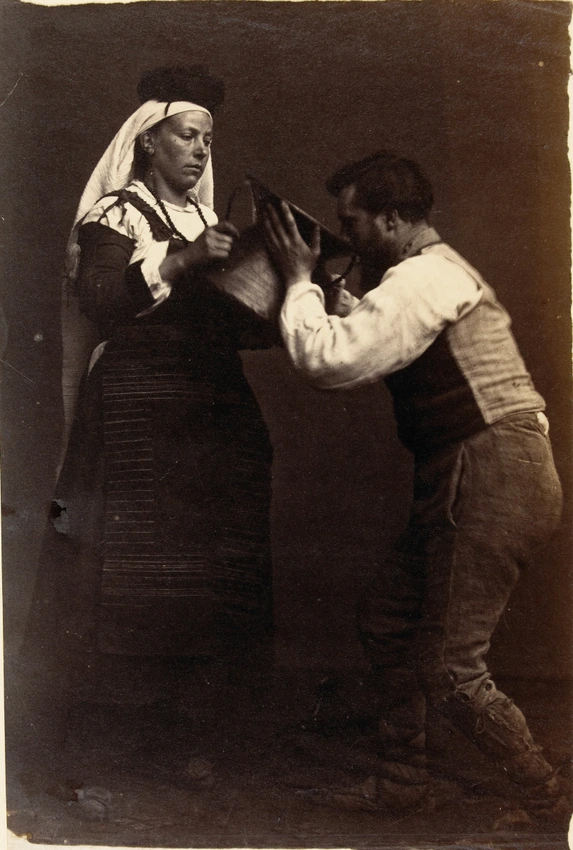
Such practices were not merely hypothetical. The Metropolitan Museum of Art’s catalog entry for Edmond Lebel’s Peasant Couple (1863–72), for example, documents the use of photography within the artistic community surrounding the French Academy in Rome. The entry explains that artists producing Italian peasant subjects sketched from life while also using photographs as documentary references for costume and physiognomy—that is, the models’ facial features and general physical appearance. A related Met study notes that photographs entered the portfolios of artists working in the Academy’s Roman milieu and that Lebel himself collected photographs before learning the medium in order to produce studies for his paintings. In addition, surviving photographs, preparatory materials, artists’ records, and subsequent scholarship document the more direct incorporation of photography into the construction of Salon pictures by other academically trained painters.
It is important, however, not to treat all of these uses as equivalent.
A photograph consulted to recall the folds of a garment or the architectural features of a distant building does not perform the same role as one whose framing, contours, tonal structure, and spatial relationships largely govern the finished painting. Nor is a photograph used as one source among many equivalent to an image transferred, enlarged, and closely reproduced as the principal basis of the composition.
The mere presence of photography in a painter’s process therefore tells us relatively little unless the nature, extent, and authority of its use are specified. Relevant questions include whether the photograph supplied incidental information or the governing structure of the picture; whether its photographic characteristics were retained, suppressed, or transformed; and whether it functioned alongside direct observation, drawings, models, textual research, memory, or other sources.
For the same reason, claims about what a particular artist did or did not do with photography require adequate documentary, technical, or material evidence. A painting may resemble a photograph without being based on one, just as a photographic source may have been substantially altered in a finished work. Visual appearance alone is therefore rarely sufficient to reconstruct an artist’s working process with confidence.
Resistance to Photography Did Not Mean Total Non-Use
It is well documented that some nineteenth-century artists, teachers, and critics regarded photography with suspicion; however, their objections were not uniform. Some concerned the limitations of photographic images as sources for drawing and painting; others concerned photography’s artistic status, its mechanical mode of production, its effects on public taste, or the possibility that literal description might be mistaken for artistic judgment and invention.
Some of the technical and pedagogical concerns were reasonable, even if the conclusions drawn from them were not always warranted. An ordinary photograph fixes a bounded view from a particular camera position and moment. Depending on the camera position, angle of view, lens characteristics, focus, exposure, lighting, the photographic process, and the quality of reproduction, these factors may alter, suppress, or emphasize information in ways that differ from sustained observation of a three-dimensional subject. A close viewpoint may exaggerate the relative size of nearer forms, while lenses can introduce barrel, pincushion, and other optical distortions. Exposure and reproduction may also compress or eliminate distinctions in highlights, shadows, color, or surface detail. This is not meant to even remotely imply that ordinary visual perception provides a neutral or distortion-free record of the world; rather, photography and human vision transform available information in different ways.
Photography’s treatment of movement also changed historically. The earliest daguerreotypes required exposures lasting several minutes, making portraiture difficult and often requiring the sitter to remain rigidly still. As photographic materials and lenses improved, shorter exposures increasingly enabled the recording of moving subjects and transitional instants. Photography could therefore blur or suppress movement in one context and isolate a fleeting instant in another.
When a photographic image is uncritically copied as the primary basis for a representational exercise, such characteristics can work against pedagogical goals centered on understanding form, structure, and spatial relationships. This does not mean that photographs necessarily prevent such understanding. It means only that reproducing the contingencies of a photograph is not the same as analyzing the three-dimensional subject it depicts. Importantly, many influential forms of academic training sought to cultivate that structural understanding. Through anatomy, perspective, cast study, modeling, and sustained work from the living figure, students were expected to conceive of the body as an articulated form occupying space rather than merely as a collection of visible contours or tonal shapes. In the nineteenth-century French system, mastery of anatomy through study of the living nude was regarded as especially important for artists aspiring to history painting.
Photography also raised broader aesthetic and philosophical concerns. Critics debated whether mechanical exactitude was equivalent to artistic truth—a notoriously unstable concept—and whether the camera’s capacity to record appearances could substitute for selection, interpretation, imagination, and pictorial invention. Charles Baudelaire’s discussion of photography in his review of the 1859 Salon provides a prominent example. Baudelaire did not deny that photography had legitimate uses. He argued that it should remain a subordinate aid to the sciences and arts, comparable in status to printing or shorthand. What he opposed was its elevation into a governing model for art and the public belief that exact reproduction of nature constituted artistic achievement. He feared that, if photography were allowed to supplant rather than assist imagination, it would contribute to what he regarded as the corruption of art.
Baudelaire was an influential critic, not an official spokesman for the French Academy. His argument should therefore be understood as evidence of a significant nineteenth-century aesthetic anxiety about photography, not as proof of a universal academic prohibition.
Such criticism demonstrates a genuine tension between artistic judgment and mechanical recording. It does not demonstrate that academically trained artists never used photographs. An artist could reject photography as the governing standard of art while still employing photographs as references, records, documentary sources, or practical aids. Opposition to photographic aesthetics is therefore not equivalent to photographic abstinence. Criticism of excessive dependence on photographs does not establish opposition to every possible use of them, just as documented use of photographs does not indicate that photographs necessarily governed the majority of the construction or appearance of the finished work.
Bouguereau: A Carefully Bounded Case
William-Adolphe Bouguereau is often introduced into discussions of academic art and photography for understandable reasons. His paintings are highly finished, and he stands as one of the most prominent representatives of nineteenth-century French academic painting. His practice must nevertheless be discussed cautiously. The polished surfaces, refined modeling, and high degree of descriptive specificity in Bouguereau’s paintings may lead some viewers to infer that they were derived from photographic sources. Those visual characteristics are not, by themselves, sufficient evidence of photographic use. Comparable effects could be developed through drawings from live models, painted studies, anatomical knowledge, transfer procedures, full-scale cartoons, layered painting, and extensive revision.
Specialist accounts describe Bouguereau’s working process as elaborate and sequential. Mark Steven Walker identifies a progression that could include preliminary sketches and tracings, an oil sketch or grisaille, highly finished figure and drapery drawings, separate oil studies of heads, hands, animals, and other details, a full-scale cartoon, and finally the finished painting. A recent technical study published by the Nelson-Atkins Museum of Art similarly describes his use of small compositional sketches, monochromatic drawings, color studies, drawings from live models, detailed studies of individual elements, and full-scale cartoons used in transferring the design to the prepared canvas.
This evidence indicates that Bouguereau’s compositions were ordinarily developed through multiple preparatory stages rather than simply transcribed from one complete, fixed source. Individual figures and details could be studied separately and then selected, adjusted, combined, and integrated into the final composition.
Walker also reports that Bouguereau possessed an extensive collection of photographs, including works by prominent and lesser-known photographers, and that he was attentive to qualities of light associated with photographic images. The existence of that collection does not, however, establish that the photographs routinely served as working sources for his paintings. A collection may contain artistic reproductions, documentary images, portraits, personal records, or visual material gathered for numerous purposes.
Walker states that Bouguereau “almost never worked from photographs” and identifies a small number of portraits—often involving deceased sitters—as exceptions that appear to have been derived from photographs. This claim should remain attributed to Walker rather than treated as a comprehensive finding that can be independently demonstrated for every work in Bouguereau’s large oeuvre. It nevertheless weighs against both categorical abstinence and routine photographic dependence.
Walker further reports that Bouguereau used a chambre claire, or camera lucida, in producing some drawings. The device enabled the artist to compare the observed subject with the drawing surface and record selected contours and details for later use. This is especially relevant to the present discussion: even a painter whose ordinary process was grounded in drawing, models, preparatory studies, and compositional synthesis was not necessarily committed to an absolute exclusion of optical assistance.
The most defensible conclusion is therefore limited. Bouguereau knew and collected photography and, according to Walker, used photographs on at least some occasions. The available evidence does not support treating photography as the ordinary primary organizing source of his paintings. His documented practice was instead multistage and synthetic, combining preliminary invention, drawings and painted studies from live models, anatomical and perspectival knowledge, full-scale cartoons, transfer procedures, and continued adjustment during execution.
Photography, when used, appears to have entered that broader process as one possible source or aid rather than as the defining basis of Bouguereau’s practice. His case therefore supports neither the claim that academic painters were necessarily “camera-free” nor the claim that a photographic appearance proves photographic dependence.
Thomas Eakins: Decisive Evidence Against an Absolute Rule
Thomas Eakins provides especially strong evidence that academic formation, realist representation, and sustained photographic practice could coexist. He studied at the Pennsylvania Academy of the Fine Arts from 1862 to 1866 while also attending anatomy lectures and demonstrations at Jefferson Medical College. Beginning in 1866, he continued his education in Paris, principally at the École des Beaux-Arts under Jean-Léon Gérôme, with additional instruction from Léon Bonnat and the sculptor Augustin-Alexandre Dumont. His formation was therefore firmly grounded in academy-based study of drawing, anatomy, perspective, and the human figure.
Eakins subsequently became deeply involved with photography. After joining the faculty of the Pennsylvania Academy, he used the camera in connection with both his paintings and his teaching. He and his students produced photographs of nude models, athletes, students, and figures in motion. The Metropolitan Museum of Art describes the school under Eakins as a “laboratory of photographic experimentation,” while the Philadelphia Museum of Art identifies his sequential photographs of nude models as teaching aids that embodied an important component of his Academy curriculum.
Photography was therefore not merely external documentation of Eakins’s work. It intersected directly with his investigations of anatomy, posture, locomotion, balance, perspective, and the structure of the human body. His photographs could function as teaching materials, analytical studies, compositional resources, and records of poses or movements unavailable for prolonged observation.
Eakins was also involved with Eadweard Muybridge’s motion studies at the University of Pennsylvania. He served on the committee associated with Muybridge’s work and experimented alongside him in 1884 and 1885. Eakins nevertheless developed procedures that differed from Muybridge’s multicamera sequences. In some of his motion studies, Eakins recorded successive phases of movement by making multiple exposures on a single photographic plate, allowing elapsed time and changes in position to be examined within a single image.
The surviving photographs and institutional records make it impossible to characterize photography as wholly external to Eakins’s artistic or pedagogical practice. His use of the medium was systematic, documented, and closely connected with the same anatomical, perspectival, and observational concerns that informed his academy-based teaching.
Eakins does not conform to every modern expectation associated with the label “academic realism”. His mature paintings differed considerably from the polished idealization associated with painters such as Bouguereau, and his relationship with the Pennsylvania Academy ended amid controversy over his methods of teaching from male models in an art class that included women. He was nevertheless academically trained, served as an instructor and later director of schools at an academy, and maintained a sustained commitment to anatomy, perspective, life study, and disciplined representation of the human figure.
Under the operational definition used in this essay, Eakins therefore provides a clear example of an academy-derived realist practice in which photography became an important artistic and pedagogical instrument. His case decisively refutes the categorical proposition that such a practice must, by definition, exclude photography.
This does not establish that every academically trained artist used photographs, that every academy endorsed their use, or that photography occupied the same place in every curriculum. It demonstrates something narrower but conclusive: photographic use was neither logically nor historically disqualifying. An artist could employ photography extensively while retaining deep commitments to academic drawing, anatomy, perspective, life study, and structural understanding.
The Use of Photography Alone Does Not Constitute Photorealism
The other side of the distinction also requires precision. In ordinary contemporary usage, photorealistic often functions as a descriptive adjective meaning that an image closely resembles a photograph. It may be applied to a graphite drawing, digital rendering, airbrushed illustration, sculpture, or highly finished painting regardless of how the work was produced.
Photorealism, as the name of a historically situated artistic movement, is considerably more specific. The movement coalesced principally in the United States during the late 1960s and early 1970s, although closely related forms of painting also developed in Europe. Artists commonly associated with its first generation include Richard Estes, Chuck Close, Audrey Flack, Ralph Goings, Robert Bechtle, Don Eddy, and John Baeder. Photorealism was distinguished not simply by a high degree of representational precision, but by its fundamental engagement with photographs as intermediaries in the construction of paintings.
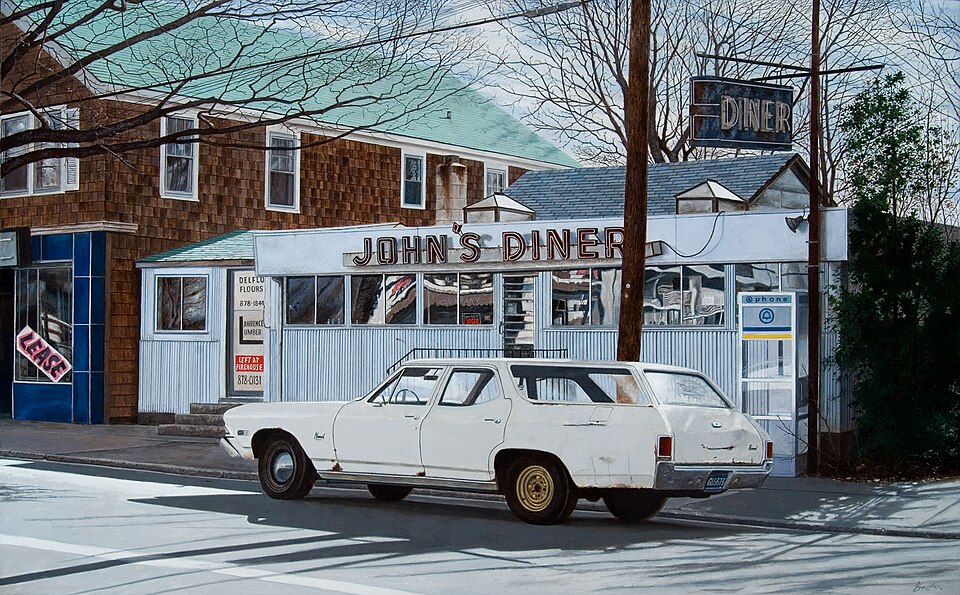
The New York art dealer, collector, and writer Louis K. Meisel is generally credited with introducing the term Photorealism in 1969; it appeared in print the following year in connection with the Whitney Museum exhibition Twenty-two Realists. Two years later, Meisel developed a five-point definition at the request of Stuart M. Speiser, who had commissioned a large collection of works by the Photorealists, which later developed into a traveling show known as ‘Photo-Realism 1973: The Stuart M. Speiser Collection‘, which was donated to the Smithsonian Institution in 1978 and is shown in several of its museums. The definition for the ‘originators’ was as follows:
The Photo-Realist uses the camera and photograph to gather information.
The Photo-Realist uses mechanical or semi-mechanical means to transfer information onto the canvas.
The Photo-Realist must have the technical ability to make the finished work appear photographic.
The artist must have exhibited work as a Photo-Realist by 1972 to be considered one of the central Photo-Realists.
The artist must have devoted at least five years to the development and exhibition of Photo-Realist work.
His formulation has been highly influential in establishing the movement’s historical boundaries, although it should be understood as the classification proposed by one of Photorealism’s principal advocates rather than as an uncontested definition binding all subsequent scholarship.
First-generation Photorealists commonly worked from photographs or photographic slides and frequently used grids, projection, tracing, masking, airbrushing, or related procedures to enlarge and transfer information to the working surface. Audrey Flack, for example, constructed arrangements in her studio, photographed them, and then transferred the resulting images to canvas using projection or a grid. Robert Bechtle similarly used projected thirty-five-millimeter color slides as the basis of his paintings.
More importantly, the photograph was not normally an incidental source consulted for a single isolated detail or general overview. It served as a necessary structural intermediary through which the subject was selected, bounded, framed, cropped, frozen, and translated into the painting.
Photorealist works often retained, examined, or transformed qualities associated with photographic images. Depending on the artist, these could include reflections and glare, enlarged detail, snapshot-like framing, fixed moments, uniform or selective focus, and spatial relationships conditioned by the camera’s position and angle of view. Photographic mediation could also affect which details appeared equally available, which moments were isolated, and how ordinary environments were converted into bounded images.
These characteristics were not applied uniformly. Richard Estes, for example, worked from photographs but frequently altered, combined, or reorganized their information. His paintings sometimes maintain sharp detail across areas that a single photograph would not render in equivalent focus. In Ansonia, he modified reflections, colors, and other details rather than reproducing a photograph unaltered. The photograph remained essential to the construction of the picture, but it was not necessarily obeyed as an inviolable template.
The distinction between Photorealism and earlier uses of photography is therefore not simply one of presence versus absence. A nineteenth-century painter might consult a photograph for a costume, face, building, pose, or anatomical detail while constructing the larger work through drawings, models, studies, conventions, and invention. In such a case, the photograph supplied limited information within a broader synthetic procedure. In Photorealism, by contrast, one or more photographic images ordinarily formed the indispensable intermediary through which the principal pictorial information was gathered and organized. The photograph could be altered, combined, intensified, or selectively translated, but the work’s structure remained fundamentally dependent upon photographic mediation.
This does not mean that every Photorealist sought merely to imitate a photograph or that every painting was intended to deceive viewers into mistaking it for one. Photorealist artists differed in subject, technique, degree of alteration, emotional distance, and conceptual purpose. Audrey Flack, for example, incorporated personal and symbolic content into compositions that remained fundamentally photograph-based.
Nor does it mean that every highly detailed painting made from photographs belongs to the historical Photorealist movement. Meisel’s original criteria partly defined a particular generation through chronology, exhibition history, and sustained commitment to the practice. Later artists may work “photorealistically” or participate in traditions influenced by Photorealism without belonging to its original historical cohort. Importantly, a painter who consults a photograph for a costume detail is therefore not necessarily a Photorealist. Neither is an artist who uses photographs extensively but transforms them according to pictorial aims unrelated to the historical movement. The relevant distinction lies not merely in whether photography entered the process, but in its function, extent, and structural authority.
Academic Training and Mature Studio Practice
Another important distinction follows from the nature of academy-based pedagogy: foundational training and mature professional studio practice are not the same thing.
An academy or atelier may reasonably restrict or omit photographic reference in particular exercises or stages of instruction. Drawing or painting from life presents perceptual, spatial, and motor challenges that can be valuable in developing observational and representational competence. The student must contend with a three-dimensional subject whose spatial relationships must be interpreted from a selected viewpoint and whose structure cannot be easily reduced to a single fixed arrangement of contours and tonal shapes.
A student working primarily from photographs may sometimes produce a convincing two-dimensional correspondence without developing an equally adaptable understanding of the forms, spatial relationships, and conditions that generated the image. This is not an inevitable consequence of photographic reference, nor does it mean that photographs cannot be used intelligently in education. It means that copying a fixed image does not necessarily demand the same perceptual judgments as sustained study of a three-dimensional subject.
For this reason, an atelier may appropriately choose to emphasize direct work from casts, objects, and living models during foundational training or to exclude photographic reference from particular assignments. That is a defensible pedagogical choice, and one with which I agree when the purpose of the exercise is to develop capacities that photographic copying might allow the student to bypass.
In my own academy, for example, I prohibit the use of a ruler during early line exercises. This is not because I have a philosophical objection to rulers or believe that their later use invalidates a drawing. Such early line exercises are specifically designed to develop control of the drawing instrument through a particular set of strategic limitations. A ruler would remove the very difficulty the student is meant to confront. The same distinction applies more broadly. A restriction imposed instrumentally for the purposes of training does not necessarily become a permanent rule governing professional practice, much less a timeless definition of an artistic category.
An artist may study anatomy from life, learn perspective through geometric construction, develop spatial understanding through cast drawing and modeling, and later use photographs for documentation, reference, compositional development, or other purposes without nullifying that education. The later use of a tool does not retroactively erase the abilities developed without it. Nor should the policies of a particular contemporary academy or atelier automatically be projected backward as universal historical standards. A modern school may adopt stricter limitations because they serve its curriculum, sequence, or educational philosophy. Such policies tell us how that school has chosen to cultivate particular abilities; they do not necessarily establish what every historical academy required or what every academically trained artist was “permitted” to do throughout a professional career.
Academy-based pedagogy concerns the cultivation of particular forms of knowledge and skill. It does not entail permanent abstention from every technology withheld during foundational exercises. A pedagogical constraint should therefore be understood in relation to the capacity it is intended to develop—not mistaken for an essential boundary separating academic art from nonacademic art.
Contemporary Ateliers Are Revivals and Adaptations, Not Exact Replicas
Many contemporary ateliers identify their programs with the academic tradition. Depending on the school, their curricula may include Bargue plate copying, cast drawing, anatomy, perspective, master copying, sight-size or comparative measurement, and extended work from the living figure. Current programs combine and sequence these practices in different ways rather than following one universally shared atelier curriculum. These schools have revived, preserved, reconstructed, and adapted important forms of skill-based education that had become less prominent within many twentieth-century art institutions. They should not, however, be regarded as exact replicas of a single historical academy or atelier.
Historical academic instruction varied among institutions, national traditions, periods, private studios, and individual teachers. Even within nineteenth-century France, training was distributed across the École des Beaux-Arts, professors’ and private ateliers, museum copying, competitions, study from casts and living models, and other forms of independent preparation. Albert Boime’s account of French academic training, for example, describes a progression involving engravings, casts, old-master copying, the living model, and landscape practice rather than one universally prescribed studio method.
The Charles Bargue Drawing Course, developed in collaboration with Jean-Léon Gérôme and published in the late 1860s and early 1870s, was an important and widely circulated instructional resource. Its nearly two hundred lithographs were organized progressively around studies after casts, master drawings, and male models. Artists including Vincent van Gogh are documented as having used it. It was nevertheless one particular published course—not the complete curriculum of every French institution, much less every European academy.
The same caution applies to sight-size. Methods based on comparing a subject and image from a fixed viewpoint have historical precedents, particularly in certain portrait and studio practices. The surviving evidence does not, however, justify presenting the modern sight-size procedure as the singular, official, or universally employed method of the École des Beaux-Arts or of academy-based instruction more generally. Contemporary ateliers may place sight-size at the center of their programs, combine it with Bargue copying, or prefer comparative measurement and other observational procedures. Those choices represent particular pedagogical lineages and modern curricular decisions, not a complete reconstruction of one historically uniform system.
Contemporary ateliers are therefore better understood as selective revivals and adaptations. They identify historical practices judged useful for present educational purposes, organize them into modern sequences, and inevitably interpret them through later pedagogical experience, available scholarship, institutional constraints, and contemporary artistic goals. Some ateliers discourage or prohibit photographic reference during foundational training, while others permit it during advanced composition, professional work, or particular stages of image development. Either policy can be pedagogically defensible when it is clearly related to the capacities the curriculum is intended to develop.
Neither policy, however, can by itself establish a universal historical definition of academic art or academic training. A contemporary school is free to adopt an instructional philosophy grounded exclusively in direct observation. That local decision may be coherent, rigorous, and educationally valuable, but it does not demonstrate that academically trained artists across different institutions, nations, and periods uniformly rejected photography or other imaging technologies.
Conversely, a contemporary atelier’s acceptance of photographic reference does not establish that photography was foundational to historical academic education. Modern permission and modern prohibition are equally insufficient as evidence of universal historical practice. The distinction remains the one emphasized throughout this essay: pedagogical methods describe how particular capacities are cultivated within a particular program. They do not necessarily prescribe every source, instrument, or working procedure that an artist may employ throughout a mature professional career. A contemporary atelier may legitimately define its own curriculum. It should not mistake that curriculum for the entirety of the historical academic tradition.
Imaging Technology Is Not the Determining Criterion
The evidence supports several bounded conclusions.
First, European art academies and the foundational pedagogical structures associated with academy-based training long predated photography and were not founded upon it. Academic art is most defensibly identified through its substantial relationship to academy-promoted standards, conventions, theories, and systems of judgment—not through the mandatory use or rejection of a particular imaging technology.
Second, artists before photography used documented geometrical, mechanical, and optical devices for certain types of observation, measurement, perspective construction, and representation. Those artists should not all be classified as academic realists, but their practices demonstrate that technologically mediated observation did not begin with photography.
Third, after 1839, photographs entered the studios and broader visual culture of academically trained artists in different ways. Some artists, teachers, and critics objected to photography or sought to limit its role; some artists used it selectively; and others incorporated it extensively into artistic research, teaching, or picture construction.
Fourth, Bouguereau’s reported collection and occasional use of photographs neither make his work Photorealist nor establish a routine dependence on photography. As a historically specific movement, Photorealism did not emerge until the late 1960s, making its application to Bouguereau anachronistic in the strict historical sense. More importantly for the present argument, photography does not ordinarily appear to have served as the primary organizing source of his documented working process. Historical Photorealism was a much later development fundamentally associated with photographic mediation and exceptionally precise representation.
Fifth, Eakins provides well-documented evidence that rigorous academic formation, life study, anatomy, perspective, and substantial photographic practice could coexist. His example does not establish that photography was universally accepted within academic culture, but it decisively contradicts the proposition that academy-derived realist practice must categorically exclude it.
Finally, historical Photorealism is distinguished not by the mere presence of photographic reference but by photography’s central and systematic role as an intermediary in the gathering, organization, and translation of pictorial information. Photorealist artists could alter, combine, or selectively transform their photographic sources; the photograph did not necessarily dictate every feature of the finished painting. It nevertheless remained structurally and procedurally fundamental. Audrey Flack’s photograph-based working process provides one clear example of that relationship.
The use or nonuse of imaging technology is therefore not, by itself, a sufficient test of academic realism.
A painting does not cease to be academy-derived solely because a photograph, projected image, camera lucida, lens-based aid, digital model, or other imaging technology contributed to its production. Conversely, working without such aids does not by itself make either an artist or a work academic.
Such tools can be used intelligently or uncritically, centrally or incidentally, visibly or invisibly. Their artistic and classificatory significance depends on what information they supplied, how much authority they exercised over the resulting image, and how they functioned within the artist’s broader training, aims, procedures, and historical context.
The more useful questions therefore concern formation, function, construction, and context.
What institutional, pedagogical, theoretical, or artistic lineage shaped the practice? To what extent was the work informed by standards or conventions associated with academic art? What role did the photograph or other imaging technology play? Did it provide limited information within a broader synthetic procedure, or did it furnish the image’s governing structure? Which characteristics of the source were retained, altered, combined, or suppressed? Is the work historically situated within academic art, the Photorealist movement, a later photorealistic practice, or another representational tradition?
Those questions produce meaningful distinctions. A simple test based on the presence or absence of imaging technology does not.
Conclusion
Academic realism and Photorealism have distinct histories, institutional contexts, working practices, and visual priorities. It is therefore entirely reasonable to distinguish between them. What the historical evidence does not support is the claim that academic realism is defined by the complete exclusion of photography.
The foundational structures of academy-based training developed independently of photography. Many influential academic programs continued to emphasize drawing, anatomy, proportion, perspective, compositional invention, engagement with established artistic precedents, and direct study from casts and living models. Academically trained artists did not, however, maintain one universal prohibition against photographs or other imaging aids. The surviving evidence ranges from Bouguereau’s documented collection and reported occasional use of photographs to Eakins’s extensive photographic investigations of anatomy, posture, and motion.
Historical Photorealism made photography central in a substantially different way. Photographs commonly served as indispensable intermediaries through which subjects were selected, bounded, framed, transferred, enlarged, and organized. Depending on the artist, the resulting paintings could retain, transform, combine, or intensify qualities associated with photographic images, including cropping, reflections, fixed moments, spatial relationships, and patterns of focus or detail. The photograph did not necessarily dictate every feature of the finished painting, but photographic mediation remained structurally and procedurally fundamental.
That is the more defensible distinction. Academic realism is not defined by technological abstinence, and Photorealism is not defined merely by technical finish or resemblance to a photograph. What matters is the role that the mediated image plays within the artist’s formation, pictorial aims, working process, and finished work.
The history of representational art is not adequately described as a contest between pure, unmediated vision on one side and mechanical augmentation on the other. Artists have long selected, measured, recorded, corrected, idealized, combined, and transformed visual information through direct observation, learned conventions, geometrical systems, optical devices, preparatory studies, memory, and imagination.
Photography—and imaging technology more broadly—belongs within that history. Its use may profoundly shape a work, or it may supply only limited information within a much larger synthetic process. Its presence or absence is therefore not, by itself, a categorical test of whether an artist or a work belongs to an academic lineage.
References
Ackerman, G. M. (1986). The life and work of Jean-Léon Gérôme: With a catalogue raisonné. Sotheby’s Publications.
Allan, S., & Morton, M. (Eds.). (2010). Reconsidering Gérôme. J. Paul Getty Museum.
Baudelaire, C. (1965). The modern public and photography. In J. Mayne (Trans. & Ed.), Art in Paris, 1845–1862: Salons and other exhibitions (pp. 149–155). Phaidon Press. (Original work published 1859)
Boime, A. (1971). The academy and French painting in the nineteenth century. Phaidon.
Danly, S., & Leibold, C. (1994). Eakins and the photograph: Works by Thomas Eakins and his circle in the collection of the Pennsylvania Academy of the Fine Arts. Pennsylvania Academy of the Fine Arts; Smithsonian Institution Press.
Dürer, A. (1977). The painter’s manual: A manual of measurement of lines, areas, and solids by means of compass and ruler (W. L. Strauss, Trans.). Abaris Books. (Original work published 1525)
Galassi, P. (1981). Before photography: Painting and the invention of photography. Museum of Modern Art.
Goldstein, C. (1996). Teaching art: Academies and schools from Vasari to Albers. Cambridge University Press.
Ho, C. I. (2020). Drawing from life: Sketching and socialist realism in the People’s Republic of China. University of California Press.
Kemp, M. (1990). The science of art: Optical themes in Western art from Brunelleschi to Seurat. Yale University Press.
Lindey, C. (1980). Superrealist painting & sculpture. William Morrow.
Meisel, L. K. (1980). Photo-realism. Harry N. Abrams.
Meisel, L. K. (1993). Photorealism since 1980. Harry N. Abrams.
Michel, C. (2018). The Académie Royale de Peinture et de Sculpture: The birth of the French school, 1648–1793 (C. Miller, Trans.). Getty Research Institute.
Newhall, B. (1982). The history of photography: From 1839 to the present (5th ed.). Museum of Modern Art.
Nochlin, L. (1971). Realism. Penguin Books.
Scharf, A. (1968). Art and photography. Allen Lane, The Penguin Press.
Steadman, P. (2025). Canaletto’s camera. UCL Press.
Talbot, W. H. F. (1844–1846). The pencil of nature. Longman, Brown, Green, & Longmans.
Walker, M. S. (1984). Bouguereau at work. In L. d’Argencourt & M. S. Walker (Eds.), William Bouguereau, 1825–1905 (pp. 71–82). Montreal Museum of Fine Arts.
Weinberg, H. B. (1994). Thomas Eakins and The Metropolitan Museum of Art (with a contribution by J. L. Rosenheim). The Metropolitan Museum of Art.
Wollaston, W. H. (1807). Description of the camera lucida. The Philosophical Magazine, 27(108), 343–347.
Institutional and object-specific sources
Académie des Beaux-Arts. (n.d.). Our history. https://www.academiedesbeauxarts.fr/en/our-history
Getty Research Institute. (n.d.). Academic art. Art & Architecture Thesaurus. https://www.getty.edu/vow/AATFullDisplay?subjectid=300056465
National Gallery of Art. (n.d.). The early history of the Accademia di San Luca. https://www.nga.gov/research/center/early-history-accademia-di-san-luca
Philadelphia Museum of Art. (n.d.). Naked series: Thomas Eakins. https://www.philamuseum.org/objects/76783
Saunders, B. (2017, April 1). The rise of paper photography in Italy, 1839–55. The Metropolitan Museum of Art. https://www.metmuseum.org/essays/the-rise-of-paper-photography-in-italy-1839-55
The Metropolitan Museum of Art. (n.d.). Edmond Lebel: [Peasant couple]. https://www.metmuseum.org/art/collection/search/730743
The Metropolitan Museum of Art. (n.d.). Jean-Léon Gérôme: Prayer in the mosque. https://www.metmuseum.org/art/collection/search/436482
The Metropolitan Museum of Art. (2004). Thomas Eakins (1844–1916): Painting. https://www.metmuseum.org/essays/thomas-eakins-1844-1916-painting
Philadelphia Museum of Art. (n.d.). Thomas Eakins: American realist. https://www.philamuseum.org/exhibitions/thomas-eakins-american-realist
Nelson-Atkins Museum of Art. (n.d.). William-Adolphe Bouguereau: Italian woman at the fountain. https://nelson-atkins.org/fpc/nineteenth-century-realism-barbizon/502/
