
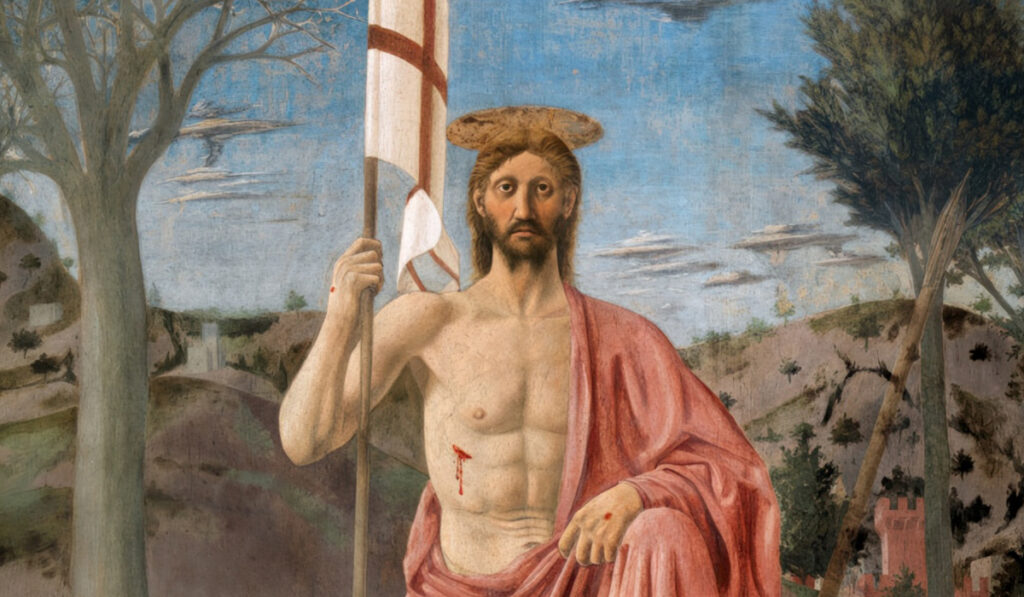

Piero della Francesca’s The Resurrection serves as a profound lesson in reverence, restraint, and human dignity.
Respect extends beyond manners, agreement, or civility. At its core, respect involves recognizing value beyond oneself: the worth of human life, the inheritance of culture, and the obligation to pause before destroying what cannot be replaced.
The history of Piero della Francesca’s The Resurrection exemplifies this concept with particular power.
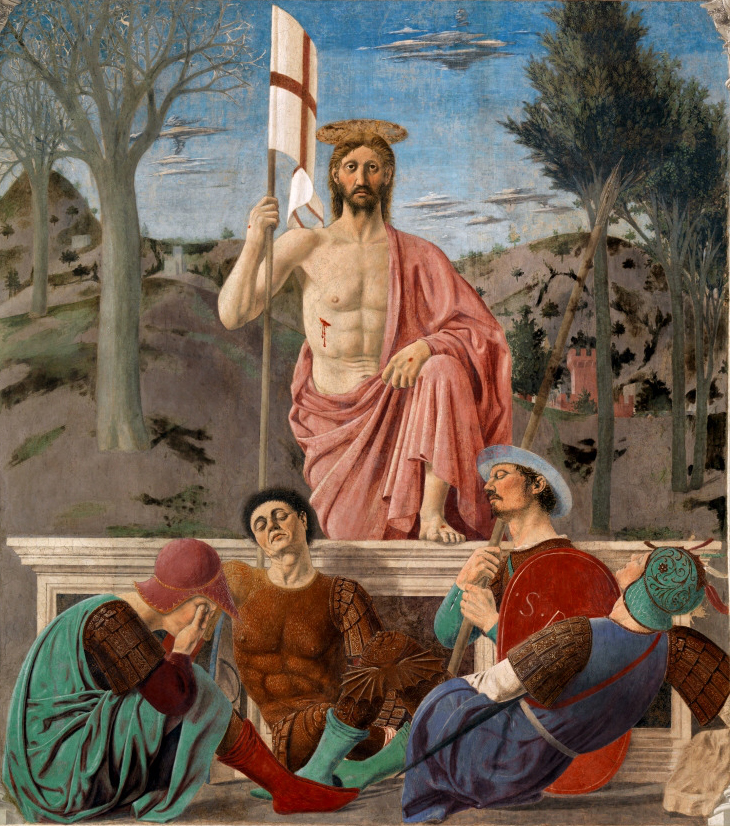
Painted in the 1460s in Sansepolcro, Tuscany, The Resurrection was commissioned for the Palazzo della Residenza, the town’s communal meeting hall. Piero, a native of Sansepolcro and a prominent figure of the Italian Renaissance, created the fresco for the room used by the Conservatori (the chief magistrates and governors), who reportedly prayed before the image prior to their deliberations. The placement of the artwork was significant: it was not intended solely for decoration, but rather situated at the intersection of civic judgment and moral responsibility.
The subject of the fresco was equally appropriate. Sansepolcro’s name refers to the Holy Sepulcher, and the depiction of the risen Christ held both local and spiritual significance. Piero’s Christ does not appear to be entering the scene with dramatic movement; instead, he seems to rise with stillness, gravity, and authority. Below, the sleeping guards are depicted in states of disorder and unawareness, while Christ stands upright, vigilant, and fully present. The painting maintains serenity without passivity, conveying power without resorting to violence.
In 1944, during the Allied advance through Italy in the Second World War, British artillery reached the hills overlooking Sansepolcro. The town was believed to contain German forces, and orders were issued to shell it. According to later accounts based on the recollections and diary of British officer Anthony “Tony” Clarke, he hesitated as the bombardment commenced. The town’s name evoked a memory: years earlier, Clarke had read Aldous Huxley’s renowned description of Piero’s Resurrection, which Huxley described as “the greatest picture in the world.” Already affected by the destruction witnessed elsewhere, including Monte Cassino, Clarke reportedly decided to halt the shelling. What would become known later was that the German forces were already retreating, rendering the bombardment unnecessary. Sansepolcro was spared further damage, and as a result, the fresco survived.
Over time, Clarke became remembered in Sansepolcro with gratitude, even attaining the status of a local hero. The narrative has understandably acquired a legendary quality, yet its essential truth remains compelling: in a moment defined by war, command, fear, and uncertainty, one officer paused long enough to regard a town, and its cultural inheritance, as more than a military target.
In this context, respect was not sentimental, nor did it require certainty or arise from expected concerns of safety. Instead, it emerged in the form of great restraint. Clarke’s decision did not ignore the harsh realities of war, but demonstrated that even in conflict, destruction is not inevitable. There are moments when the application of force is easy, and reverence is challenging. Great forms of respect can originate in such moments of significant difficulty.
The painting itself reinforces this lesson. Piero’s Resurrection embodies a profound balance between civic and sacred life, mortality and renewal. Its composition reflects a sense of order: Christ rises from the tomb with monumental calm, while the landscape transitions from barrenness to vitality. Art historians have frequently noted the painting’s poise, geometry, and stillness. While it is a Renaissance masterpiece, it also serves as an intimate image that invites viewers to contemplate deeply. This context underscores the significance of the wartime narrative. The preservation of the fresco was not merely the safeguarding of an old wall painting, but the continuation of a human dialogue across centuries. The same image that once challenged magistrates to exercise wisdom later confronted a soldier with the necessity of restraint. In both instances, the fresco functioned as a test of both priority and character.
Respect also entails acknowledging that culture is not a luxury. During periods of crisis, art is sometimes regarded as relevant only in times of peace, or as an optional addition after more pressing matters are addressed. However, the Resurrection suggests otherwise. Art can clarify the true nature of what is important, restore a sense of proportion, and disrupt the momentum of destruction through memory, conscience, and perspective. Respecting a masterpiece does not imply valuing art above human life. Rather, it reflects an understanding that human beings are far more complex than may be seen or expected at face value in many contexts. Humans are indeed combatants, economic agents, or political entities, but they are also creators, inheritors, believers, mourners, and thinkers. Societies leave behind not only physical remnants, but also touchstones of great meaning. Protecting culture is an act of respecting both the lives that shaped it and the future generations entitled to experience it.
Another dimension of respect is evident: respect for mystery. The New Testament does not provide a literal account of Christ’s resurrection. Piero lacked an eyewitness narrative to guide his depiction. Instead, he created a vision of resurrection characterized by presence, authority, and awakening. The work does not seek to explain everything; it remains dignified and steadfast, inviting contemplation rather than distraction. This quality may explain the story’s continued resonance. Contemporary society is characterized by rapid reactions, a tendency to diminish value, and a propensity to treat attention as expendable. Respect requires the opposite: to pause, to discern, and to acknowledge that certain matters warrant care before commentary and reverence before reaction.
Piero della Francesca’s The Resurrection has endured centuries, neglect, and war. Its survival is notable. However, the more profound phenomenon may be the human instinct, evident throughout history: the impulse, however fragile, to refrain from destruction out of respect for what is enduring and sacred.
In this sense, the narrative is not solely about preserving a painting during wartime. It is an account of the manifestation of respect under the most critical circumstances.
