


A study from Shanghai Jiao Tong University (School of Design) in China made some waves in 2019 (pun intended) with a careful investigation into an often-encountered yet relatively under-examined bit of ornamentation—decorative wallpaper (Fu, Zhang, & Lin, 2019). Using a test that is designed to assess the strength of cognitive associations by examining latencies in classification tasks (Implicit Association Test), eighty willing participants demonstrated a strong preference for, in terms of semantic decodability (assigning meaning according to convention), regular (repeating motifs) and realistic patterns over random and abstract ones. And while I would not stretch such a narrow study to make unwarranted, general assumptions about the grand landscape of the “art experience,” such an exploration may help us better understand why regular, naturally occurring patterns continue to find their way onto our canvases.
It should be noted here that while patterns can be described as discernible regularities, natural patterns are often set apart as those discernible regularities that occur in nature, independent of human artifice. These patterns can be usefully contrasted, in certain contexts, against what some may describe as “man-made” patterns (such as those regularities found with abstraction, mathematics, cognition, design, and language). However, in many cases, the clear divisions between these categories can be blurred or even completely lost. One such case is the arts.
Symmetries, spirals, tessellations, fractals, waves, foams, meanders, stripes, and other natural patterns have been finding their way into artistic endeavors since our ancestors first started shaping stones and marking cave walls. This should come as no surprise, as what we describe as visual art is a product of unrelenting pattern-seekers that have evolved to seek out such visible regularities within the environment to inform the countless prediction tasks that facilitate our survival and reproduction. In fact, our reliance on visible patterns is so significant that the perception of such regularities tends to elicit what we might describe as an aesthetic response.

Today, many brilliant minds continue to investigate why specific patterns trigger the emotionally charged adaptive responses they do. (Ulrich 1983), (Spehar, Branka, et al., 2003). And while there do appear to be many compelling ideas about why this or that pattern in nature may elicit a positive aesthetic response, I would argue that, in most cases, processing fluency does much of the heavy lifting. According to the processing fluency theory, the more fluently a perceiver can process an object, the more positive his or her aesthetic response. This concept is presented in the aforementioned study on decorative patterns: “Fluent processing produces a positive affective response, which is often attributed to subjective preference (Reber, Schwarz, et al., 2004). In this theory account, processing fluency is considered to be comprised of perceptual fluency and conceptual fluency, with the former influenced by low-level processes related to the forms of stimuli, and the latter influenced by high-level variables such as semantic guidance or semantic predictability (Reber, Wurtz, & Zimmermann, 2004).”
For example, it is well established that within many contexts, humans exhibit a strong preference for symmetrical over asymmetrical or random shapes (Jacobsen & Höfel, 2002; Reber, Schwarz, & Winkielman, 2004). Many argue that this preference is due to our associations of symmetry with good health/genetics. (Grammer & Thornhill, 1994; Jones et al., 2001; Møller & Thornhill, 1998.) However, others point to more recent studies of the associations between health and symmetry to argue otherwise (Pound, Nicholas, et al., 2014). In either case, the discernible regularity–pervasive in all living things–is usually processed (cognitively and perceptually) with great ease—often regardless of position and orientation (Enquist, Magnus, and Arak,1994).
Fractals, another form of self-similarity, are also prevalent throughout nature. They can be found in the forms of trees, clouds, and coastlines. Through exposure to nature’s fractal scenery, our visual systems have adapted to process fractals efficiently—so much so that the specific processing fluency of this pattern has been dubbed fractal fluency. (Taylor, R. P., & Spehar, 2016).
I would argue that it is our evolved fluency with natural patterns that allows the aesthetic influence (at least in part) to survive translation through “man-made” pattern processes, such as mathematical models or representational efforts carried out by skilled creatives. In fact, existing research has shown that such translations are indeed capable of eliciting comparable positive aesthetic responses to those found “naturally.” (Spehar, Branka, et al., 2003.) A simple visit to just about any museum today can be a journey through the history of the artistic application of such visual regularities. From Georgia O’Keeffe’s bold, colorful expressions of symmetrical subjects to Bierstadt’s lavish landscapes riddled with virtuoso fractal-like foliage, adept creatives have long used natural patterns to their aesthetic advantage.
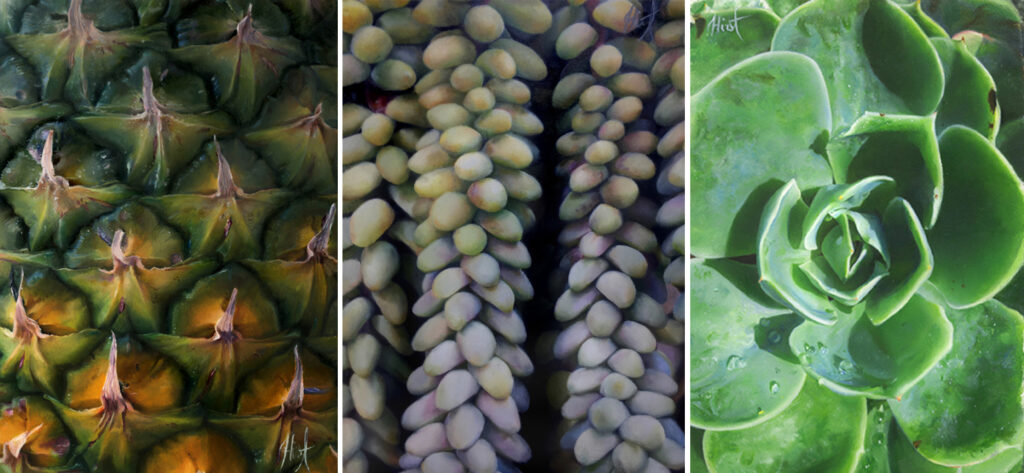
And while we do indeed find many “successes” with natural pattern translation throughout the broad landscape of the visual arts, there also exist a good number of applications that I would unapologetically describe as ineffective (if not downright nonsensical). These applications do not communicate nor translate the perceptible, discernible regularity of a natural pattern that is subject to fluent processing, but rather, attempt to translate some “extracted” component of the pattern’s structure or extract some component of a translation. These convoluted transformations HAVE NOT been convincingly demonstrated to yield comparable aesthetic influence. Such transformations are often used in pictorial composition, serving as compositional armatures or design mechanisms.
Two specific cases that continue to find support among contemporary creatives are the Golden Ratio/Spiral and Dynamic Symmetry. In both cases, proponents claim that elements can be extracted from a mathematical translation of a natural pattern while retaining the original pattern’s aesthetic impact. Additionally, proponents argue that the new extraction can infuse an entirely new context with some of the source’s aesthetic potential. Unfortunately, a fact that seems to elude those who subscribe to such strategies is that the aesthetic response found with the perception of the original pattern is not a property that is equally distributed throughout all conceivable aspects of the pattern, let alone isolatable within extracts of translations.
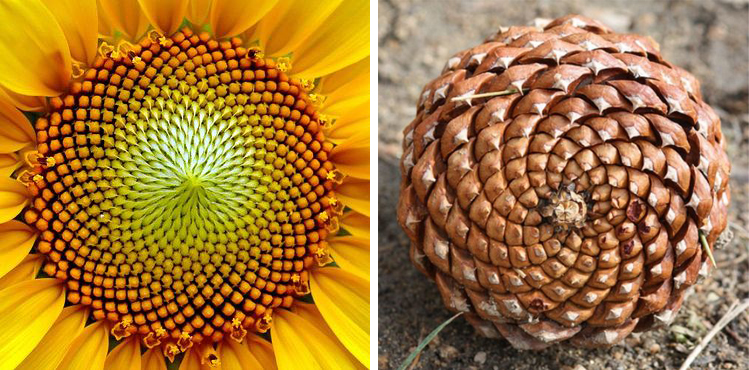
The correspondence between the arrangement of sunflower florets and pinecone spirals and the Fibonacci sequence is often put forward as evidence for claims of aesthetic advantage based on Dynamic Symmetry (DS) and the use of the Golden Ratio (GR). The strategies for reassigning the aesthetic impact found with these natural patterns, according to many DS & GR proponents, require the extraction of a mathematical sequence from the observed pattern, followed by a translation into a geometric armature that is capable of, via alignment, imbuing a new context with the aesthetic potential inherent to the original pattern.
Furthermore, such translation-component extraction-reassignment strategies seem to overlook the vital role of fluency in the aesthetic responses found with natural patterns. The further you move (perceptually) from the stimulus that we have evolved aesthetic responses to, the more diminished those responses should become. If such a strategy were sound, one could reassign any potential aesthetic impact via an extraction taken from a translation of a stimulus. For example, I could write a song about “12, 22, and 11” to provide an aesthetic response comparable to that experienced when consuming sugar. (The white stuff we know as sugar is sucrose, a molecule composed of 12 atoms of carbon, 22 atoms of hydrogen, and 11 atoms of oxygen (C12H22O11)
Canadian-born American artist and author Jay Hambidge put forward his idea of Dynamic Symmetry in the 1920s, in which he claimed that patterns found among growing plants and human figures formed “the basic principles underlying the greatest art so far produced in the world.” However, rather than use the perceivable patterns shown to elicit actual aesthetic responses, Mr. Hambidge took the measurements and proportions of such patterns and built them into a series of design elements and compositional armatures. Unfortunately, his efforts were little more than an exercise in the fallacy of division, driven by a fundamental misunderstanding of the nature of aesthetic responses. Fortunately, others were able to spot the fatal errors in his reasoning fairly quickly after he published. Author William Blake (not the poet) stated in his 1921 Criticism of Dynamic Symmetry, “The claim that Dynamic Symmetry in any way expresses the essentials of plant and animal forms is without rational foundation…The attempt to base differences of artistic quality on the distinction between rational and irrational quantities, whether of length or area, is bound to fail — the eye is powerless to make the distinction.” In other words, Mr. Hambidge’s unsubstantiated claims aside, we cannot experience an aesthetic response to something that we cannot perceive.
It is at this point in most of my lectures or discussions on this topic (mentioning that we cannot find aesthetic responses to the imperceptible) that someone inevitably brings up some idea of “subliminal detection/perception/stimulation.” They suggest that perhaps some subliminal influence arises from the seemingly undetectable aspects extracted from the natural patterns on which they are based. Some go even further and attempt to substantiate this idea by citing the all-too-famous “Vicary Experiment,” in which market consultant James Vicary claimed he could increase sales of Coca-Cola and popcorn by exposing audiences to marketing messages for .003 seconds (well below the perceptual threshold). Unfortunately for proponents of subliminal messaging who continue to tout this tale, the fact of the matter is that it never happened. After failed attempts to recreate the results of his “study,” when pressed, Mr. Vicary confessed that he had falsified the results from his original study. Worse yet, in a 1962 interview with Advertising Age, Vicary revealed that the entire “study” was a hoax. Now, this is not to say that subliminal detection/perception/stimulation in the context of this article is complete nonsense. There is much ongoing research in this area being conducted with great care. However, at present, the effects demonstrated seem to be extremely transient and bear little to no resemblance to the general concept promoted in popular culture.
All in all, I expect the walls of our museums, galleries, homes, and workplaces to continue to host countless perceptible references to and representations of natural patterns. Whether they are eliciting positive responses due to processing fluency, mate selection, habitat selection, or anything else that might appeal to the great grey and white prediction machine, such patterns remain a well-established fundamental component of the visual arts. So the next time you find yourself gazing into a canvas that gives you great pleasure, look for a natural pattern that may be contributing to the experience.
I would like to offer a special thank-you to colleagues Maneesh Yadav and Michael Carson for their help and advice on this article. I am very grateful for their time, expertise, and generosity.
