

Perseverance is often described as the ability to keep going. We picture the artist returning to the easel day after day, determined to finish the work. But perseverance in the studio is rarely about simply working harder. More often, it is about finding different ways to move forward.
Every artist eventually encounters a challenge: an inadequate reference, a difficult passage, unexpected material behavior, or a composition that simply isn’t working. These moments can be frustrating, but they are also where artistic growth begins. More importantly, they remind us that every problem has the potential to become an opportunity to learn.
The Problem Is the Opportunity
Imagine painting a delicate veil from a poor-quality photograph. The reference provides the overall shape, but little useful information about transparency, texture, subtle value shifts, or the way the fabric interacts with the form beneath it. At that point, the artist has two choices: accept the limitations of the reference or begin searching for solutions. That solution might involve experimenting with paint application, gathering additional references, recreating the lighting, studying similar materials from life, or building a simple setup to better understand the subject. The first attempt may fail. So might the second. Yet every attempt provides information. This is where perseverance becomes inseparable from problem-solving. Success doesn’t come from repeating the same unsuccessful approach. It comes from remaining committed to the goal while being willing to change the path.
Artists’ Toolbox
Artists have always embraced tools that help them better understand the visual world. Today’s artists have access to a broader range of resources. Every tool exists to answer a question, solve a problem, or reveal information that was previously difficult to see. The challenge for the modern artist is not deciding whether technology belongs in the creative process. It is learning how to use these tools while maintaining artistic integrity and sound judgment.
Modern Tools That Help Artists Solve Problems
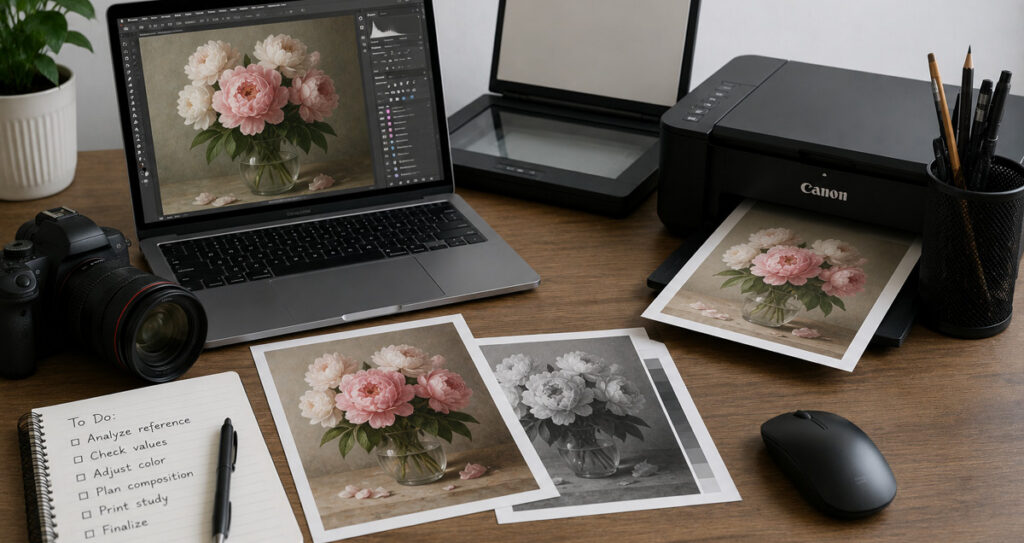
One of the greatest advantages available to artists today is the ability to move seamlessly between the physical and digital studio. Modern technology offers countless ways to investigate visual problems before committing paint to canvas.
Digital Cameras
A camera is far more than a device for taking reference photos. It allows artists to control lighting, viewpoint, depth of field, and composition. Photographing your own reference gives you the freedom to answer visual questions instead of accepting the limitations of someone else’s image.
Scanners
A high-quality scanner creates detailed digital copies of drawings, paintings, and studies. Once digitized, artwork can be enlarged to inspect edges, proportions, value transitions, and subtle drawing inaccuracies that may be difficult to notice with the naked eye. Scanning also creates a visual record of your progress. Comparing earlier stages of a painting often reveals exactly where improvements occurred, or where the work began drifting away from the original intention.
Photo Editing Software
Programs such as Photoshop have become invaluable studio assistants. References can be cropped, rotated, flipped horizontally to expose drawing errors, converted to grayscale for value analysis, or adjusted to compensate for poor lighting and incorrect exposure. Multiple photographs can be combined into a single reference, allowing artists to build compositions that would have been difficult or impossible to capture in a single photograph. Before a single brushstroke is made, an artist can experiment with cropping, backgrounds, lighting, color, and compositional balance.
Printers
Printers bridge the gap between the digital and physical studio. Printing references at different sizes, or creating grayscale versions, often reveals relationships that are easily overlooked on a brightly lit monitor. Artists can sketch directly onto printed copies, compare multiple compositions side by side, test cropping options, and make notes before committing to the final artwork. Sometimes holding a physical print in your hand changes the way you see the image.
Tablets and Mobile Devices
A tablet beside the easel provides immediate access to references without constantly returning to the computer. Artists can zoom into small details, compare multiple references, rotate compositions, photograph works in progress, and quickly identify proportion or value issues that become difficult to recognize after hours of concentrated painting. Sometimes simply viewing a painting through the camera on your phone reveals mistakes that seemed invisible moments before.
3D Modeling and Lighting Software
Occasionally, the perfect reference simply doesn’t exist. Digital models can be rotated, posed, and illuminated from any direction, allowing artists to study perspective, cast shadows, and complex forms before building a physical setup. These tools are especially valuable when exploring difficult lighting situations or understanding three-dimensional form from multiple viewpoints.
AI-Assisted Tools
Artificial intelligence has introduced another set of tools that can assist artists when used thoughtfully. AI can upscale low-resolution images, reduce digital noise, isolate subjects, extend cropped photographs, or generate variations that may inspire compositional ideas. However, artists should understand an important distinction: some tools reveal existing information, while others generate new information. That doesn’t make the tool unusable, but it does mean the artist must evaluate the result rather than simply trust it.
Technology can provide possibilities. Only the artist can determine whether those possibilities are true to the subject and appropriate for the work.
Experience Is Built One Problem at a Time
Every obstacle leaves something behind. A difficult passage teaches us more about materials. A weak reference teaches us how to gather better information. A failed composition sharpens our understanding of design. An unsuccessful experiment eliminates one possibility while pointing us toward another. Over time, these lessons accumulate into what we simply call experience.
Experience is not measured by how few challenges an artist faces, but by how they respond to them. The artists who continue to grow are the ones who meet each obstacle with curiosity rather than frustration, always asking, “What else can I try?”
