

From Medieval Masterpiece to Modern Symbol of Renewal
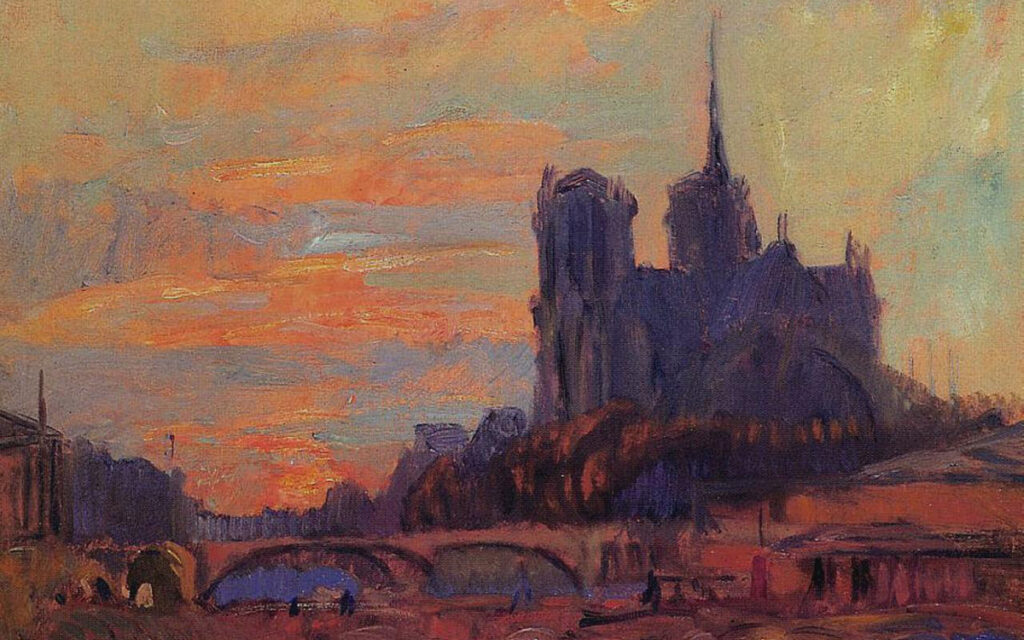
Cover image: Albert Levourg, Notre Dame de Paris, oil, c. 1895
Some buildings are more than the work of a single generation. They are shaped by the centuries that follow, as each age repairs, restores, and reimagines what came before. Few places illustrate this more clearly than Notre-Dame Cathedral in Paris. When Notre-Dame de Paris caught fire in April 2019, the world watched in disbelief. Images of the cathedral’s collapsing spire and burning roof quickly became symbols of cultural loss, prompting an outpouring of grief that extended far beyond France. For many, the fire appeared to threaten an untouched survivor of the Middle Ages. It is a monument that has endured for centuries largely unchanged. The famous spire that collapsed was not medieval at all, but a nineteenth-century creation, built during one of the most ambitious architectural restorations of its time.
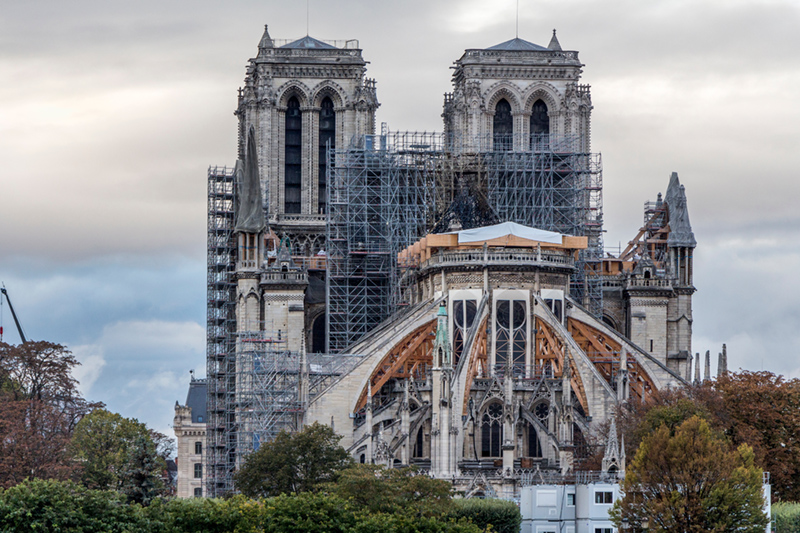
Notre-Dame has never belonged to a single era. For over 850 years, it has been rebuilt, expanded, altered, damaged, restored, and reimagined. Rather than preserving a single historical moment, the cathedral records the changing priorities of the societies that shaped it. Medieval craftsmanship stands among Renaissance additions, Baroque renovations, Revolutionary destruction, Victorian restoration, and twenty-first-century conservation. Each generation has left its mark, creating a monument that reflects not only the history of France but also the evolving relationship between art, faith, and national identity.
Seen in this light, Notre-Dame is less a relic than a living historical document. Its significance lies not in remaining frozen in time, but in the continuous dialogue between past and present that has defined its existence.
An Ambitious Medieval Experiment
Construction of Notre-Dame began around 1163 under Bishop Maurice de Sully on the Île de la Cité, replacing an earlier Romanesque cathedral. Like most great medieval churches, it was never intended to be completed within a single generation. Gothic cathedrals were not built from fixed architectural plans that remained unchanged until the final stone was laid. Instead, they evolved over generations as engineering knowledge advanced, artistic tastes shifted, and practical challenges demanded new solutions.
The cathedral emerged during the formative years of Gothic architecture, a style that transformed both the engineering and spiritual ambitions of medieval Europe. Its soaring height and luminous interior were not simply demonstrations of technical achievement. Medieval theologians associated light with the divine presence, believing that architecture could elevate the soul toward God. Notre-Dame was designed to inspire awe through its use of space, light, and proportion, making the building itself an expression of religious devotion.
Its innovations were revolutionary. Rib vaults distributed weight more efficiently, allowing ceilings to rise to unprecedented heights. Pointed arches offered greater structural flexibility than their Romanesque predecessors, while increasingly sophisticated flying buttresses carried the immense weight of the roof outward, freeing the walls for expansive stained-glass windows. Together, these advances transformed the interior into a luminous space where colored light became an integral part of worship.
Art historians often describe Gothic cathedrals as opera magna, or “great works,” because they united multiple artistic disciplines into a single coherent vision. Architecture, sculpture, stained glass, painting, and metalwork were conceived as parts of one vast artistic and theological program. Every carved portal, every painted surface, and every stained-glass window contributed to a carefully ordered image of the Christian universe. Notre-Dame was never intended to be admired solely as an architectural masterpiece. It was designed to be experienced.
A Cathedral in Constant Evolution
Contrary to modern assumptions, medieval builders had little interest in preserving an “original” design. As resources increased, artistic techniques improved, and liturgical practices evolved, they believed the cathedral should evolve as well. Honoring God often meant improving the building rather than leaving it untouched.
Art historians sometimes describe this process as the “biography” of an object. Great monuments acquire meaning over centuries as successive generations adapt them to changing needs and cultural values. Notre-Dame is among the finest examples of this idea. Its history is not a sequence of replacements but a continuous process of addition and transformation.
By the fourteenth and fifteenth centuries, the cathedral already appeared old to Parisians. Gothic architecture itself had evolved, and newer tastes encouraged further refinement. Windows were enlarged to admit more light, delicate stone tracery became increasingly elaborate, additional chapels were constructed around the nave, and structural repairs addressed the natural movement and aging of the immense building. Each alteration respected the existing structure while introducing new artistic ideas. The successive generations did not erase the past; instead, they built upon it.
The Renaissance brought another chapter of change. Although France embraced classical ideals more gradually than Italy, Notre-Dame reflected the shifting artistic climate. New altars and liturgical furnishings appeared within its Gothic interior. Wealthy patrons commissioned monuments inspired by classical forms. These additions enriched the medieval cathedral. They created the layered architectural character that distinguishes Notre-Dame today.
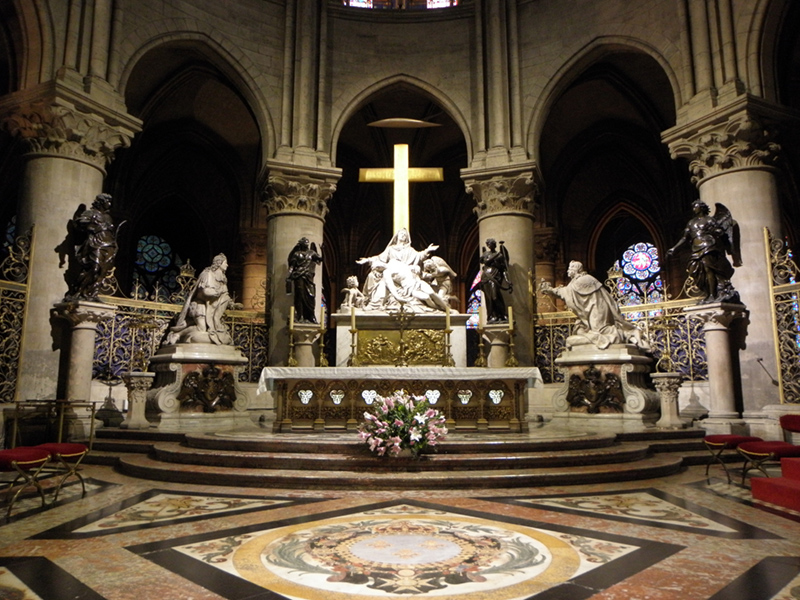
During the seventeenth and eighteenth centuries, the Counter-Reformation introduced yet another transformation. Following the Council of Trent, Catholic churches throughout Europe were redesigned to support a more dramatic and emotionally engaging style of worship. Under Louis XIV, Notre-Dame underwent significant Baroque renovations. Portions of the medieval choir screen were removed to improve visibility, new altars reshaped the sanctuary, and richly carved sculptures and furnishings reflected the age’s theatrical grandeur. Baroque art sought to engage the senses through movement, ornament, and spectacle, encouraging worshippers to experience faith as vividly as they contemplated it. By this point, Notre-Dame already embodied nearly six centuries of artistic change. Far from remaining a medieval time capsule, it had become something richer: a monument that carried the imprint of every generation that had cared for it.
Revolution and Ruin
By the late eighteenth century, Notre-Dame had stood at the heart of Paris for more than six hundred years. It had witnessed royal ceremonies, religious festivals, and moments of national celebration, becoming both a spiritual center and a symbol of the French monarchy. That close association with the ancien régime would soon place the cathedral in grave danger.
The French Revolution transformed attitudes toward churches across the country. To many revolutionaries, cathedrals represented not only religious authority but also centuries of aristocratic privilege. Across France, ecclesiastical treasures were confiscated, monasteries dissolved, and church buildings repurposed or abandoned. Notre-Dame escaped demolition, but not devastation. Its bells were melted down for cannon, precious liturgical objects were seized, and many sculptures were destroyed. Most famously, the twenty-eight statues lining the Gallery of Kings above the west façade were mistaken for images of the kings of France rather than the biblical Kings of Judah. Viewed as symbols of monarchy, they were pulled down and decapitated. Ironically, the surviving fragments were rediscovered in 1977 during excavations in Paris, revealing one of the Revolution’s most enduring misunderstandings.
The cathedral itself was stripped of much of its religious identity. It was rededicated as the Temple of Reason and later the Temple of the Supreme Being, reflecting the Revolution’s attempts to replace Christianity with civic and philosophical ideals. Christian imagery disappeared beneath revolutionary symbolism, and sacred ritual gave way to political ceremony. Yet even in its damaged state, Notre-Dame endured. Its survival reminds us that great monuments often outlast the ideologies that seek to redefine them.
Napoleon and a New National Symbol
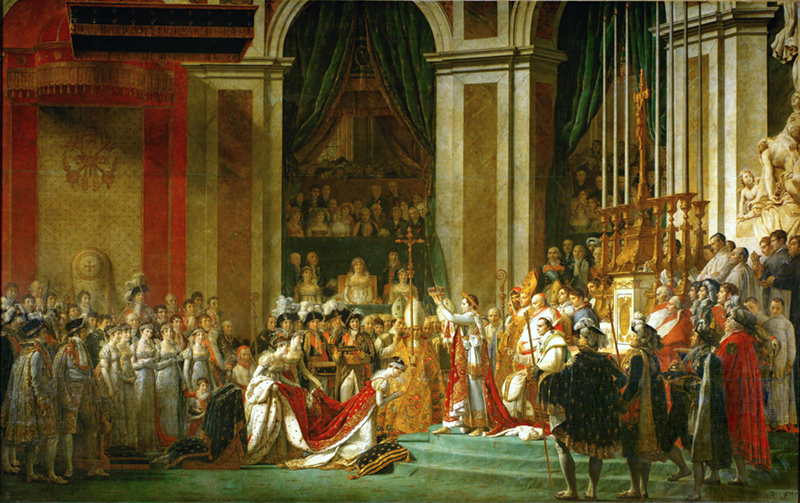
Notre-Dame entered a new chapter in 1804 when Napoleon Bonaparte chose the cathedral for his imperial coronation. Jacques-Louis David‘s monumental painting The Coronation of Napoleon immortalized the ceremony, presenting the medieval cathedral as the stage upon which a new political order announced itself. The building’s Gothic architecture provided a striking backdrop for an event carefully designed to unite imperial ambition with historical legitimacy. The coronation did not restore Notre-Dame to its former condition. Decades of neglect had left the cathedral structurally weakened and aesthetically diminished. Weathering, vandalism, and piecemeal repairs had taken their toll. By the early nineteenth century, many Parisians regarded the once-magnificent church as an aging relic whose future was increasingly uncertain.
When Victor Hugo published Notre-Dame de Paris in 1831, he wrote at a time when medieval architecture was widely misunderstood and frequently neglected. Classical styles dominated public taste, and many Gothic buildings had fallen into disrepair or faced demolition. Hugo feared that France was allowing its architectural heritage to disappear. His novel brought this situation to France’s attention. Although modern readers often remember Quasimodo and Esmeralda, Hugo intended the cathedral itself to be the story’s true protagonist. He described its towers, galleries, and sculptural programs with extraordinary detail, portraying the building as a witness to centuries of human history. Through fiction, he encouraged readers to see medieval architecture not as obsolete, but as an irreplaceable expression of French culture.
The novel became an international success and inspired a new appreciation for Gothic architecture. Public attitudes shifted, preservation efforts gained momentum, and Notre-Dame came to be viewed not simply as a church but as a national treasure worthy of protection. Few works of literature have altered the fate of a building so profoundly. Hugo demonstrated that storytelling could preserve cultural heritage as effectively as stone and mortar.
Layers of History, Not Replacement
Growing public concern eventually persuaded the French government to undertake a comprehensive restoration. In 1844, architects Jean-Baptiste Lassus and Eugène Viollet-le-Duc were appointed to lead one of the most ambitious conservation projects of the nineteenth century. Following Lassus’s death in 1857, Viollet-le-Duc assumed primary responsibility for the work and transformed the restoration into a defining achievement of his career. Today, the word restoration often suggests returning a monument to its original appearance. Viollet-le-Duc understood the term differently. He famously argued that to restore a building was “to re-establish it in a complete state that may never have existed at any given moment.”
His philosophy reflected nineteenth-century Romanticism, which valued the spirit of the Middle Ages as much as its surviving fabric. Where historical evidence was incomplete, he believed an architect should complete the design according to the building’s underlying logic rather than merely preserve its existing condition. This approach remains controversial. Modern conservation generally favors minimal intervention and the preservation of authentic material, whereas Viollet-le-Duc embraced careful reconstruction and creative interpretation. Yet judging his work solely by contemporary standards overlooks the intellectual climate in which he worked. His goal was to restore what he believed the cathedral was always meant to become.
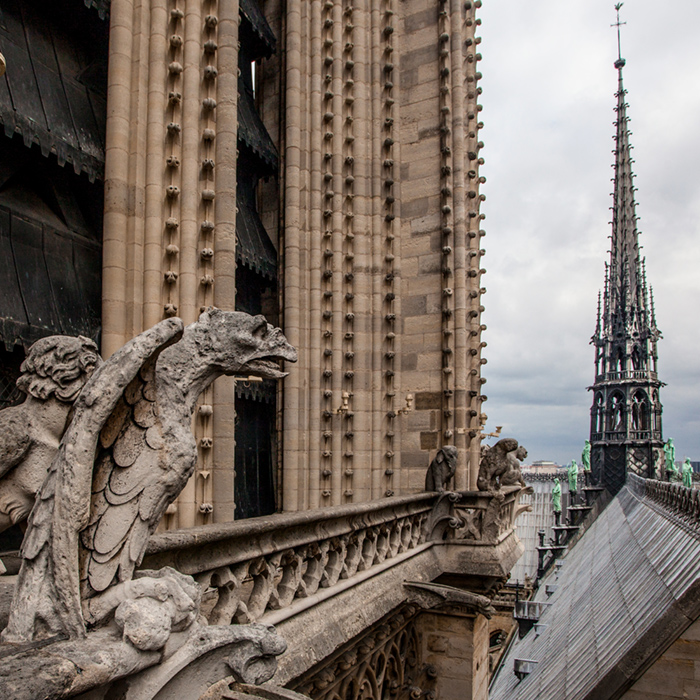
Many of Notre-Dame’s most recognizable features date from this campaign. Viollet-le-Duc designed the soaring central spire that became one of the defining landmarks of the Paris skyline. He restored damaged sculpture, reconstructed pinnacles and decorative elements, repaired structural weaknesses, and commissioned the now-famous gallery of chimeras whose dramatic silhouettes overlook the city from the upper terraces. These fantastical creatures are often mistaken for medieval gargoyles, yet they are products of the nineteenth century.
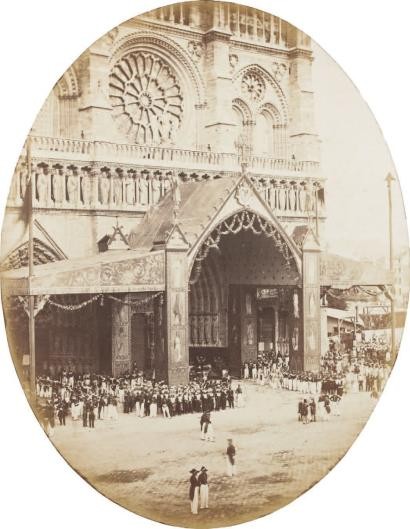
By the time the restoration concluded in 1864, Notre-Dame had once again become one of Europe’s great monuments. Yet it was no longer simply a medieval cathedral. It was a collaboration across centuries, shaped by builders, revolutionaries, writers, architects, and craftsmen whose contributions collectively defined its identity. The restoration did more than rescue a deteriorating building. It transformed the way generations would understand and value architectural heritage, establishing principles that continue to influence debates about conservation today.

1 Comment
I do despise the industrial look of modern architecture. I long for the days when we move back to these ornate designs!