


Abstraction, Recognition, and the Visual Brain
A few years ago, I created a social media post to see just how little visual information people needed to identify a famous work of art. To my delight, Realism Today picked it up and adapted it for their digital magazine. For this issue of Smartermarx Magazine, I’d like to revisit that original exercise—not simply as a game of recognition, but as a way to examine one of the most fascinating features of human perception: our ability to recognize images, objects, and compositions despite dramatic changes in detail, scale, orientation, and abstraction.
One fascinating aspect of the human brain that visual artists rely on quite consistently is perceptual constancy: our ability to perceive stable qualities in the world despite changes in the information reaching the eye. Size, shape, color, orientation, and identity may appear relatively stable even as lighting, distance, angle, scale, or context changes. Within this larger family of perceptual abilities is what vision researchers often call object constancy: the capacity to recognize an object as the same object across changes in viewpoint, position, rotation, size, or visual detail. (This should not be confused with object permanence, the developmental concept that an object continues to exist even when it is no longer visible). Here, the concern is not whether the object exists when hidden, but how the mind recognizes something as the same thing when its appearance has changed.
For artists, this is not a minor perceptual feature. It is one of the basic conditions that makes pictorial representation possible. A representational painting is never the “thing” itself. It is pigment on a surface, arranged through shape, edge, proportion, color, value, and other visual relationships in such a way that the viewer’s perceptual system organizes those marks into the experience of an image. Interestingly, the artist does not need to reproduce every perceived detail of a face, tree, hand, room, or figure for recognition to occur. In fact, many artists and theorists have argued that an overabundance of detail—however one defines “too much”—can sometimes distract from, rather than support, recognition. What matters is not simply how much infomration you can pack in, but rather whether the “essential”, relevant relationships have been achieved, emphasized, or preserved.
This is why recognition can occur so successfully amid changes in scale, orientation, medium, style, and resolution. A face may be recognized in a charcoal sketch, a blurred photograph, a caricature, a mosaic, a reflection, or even a few blocks of color. The visual system is not merely recording isolated details. It is organizing information into structure: proportion, contour, contrast, spatial arrangement, characteristic color, and the larger “gist” of the scene. Research on visual recognition has shown that object perception depends on both bottom-up information (starting with light patterns that fall on the retina and the early visual processing they initiate) and top-down influences (such as memory, context, expectation, and prior experience). In art, these processes are constantly working together.
This helps explain why abstraction can be so powerful. Abstraction is often better understood not simply as the removal of information, but as the selective preservation, emphasis, and/or reorganization of it. A successful abstraction in representation may strip away what we deem “unnecessary” or redundant while retaining the information and relationships that allow recognition, feeling, or meaning to remain intact. A viewer may not be given every feature with an abstracted representation, but enough of the visual identity remains for the mind to reconstruct the whole.
We can experience this for ourselves in the examples that follow. Many of these famous masterworks remain recognizable even when heavily simplified because their compositions possess a durable visual architecture: a particular larger-scale distribution of dark and light, a memorable arrangement of key elements, a distinctive color configuration, or a dominant directional movement. Even when fine detail is stripped away, enough of the image’s low-spatial-frequency structure (its broad masses, larger contrasts, and directional organization) may remain to support recognition. The viewer recognizes not only objects within the painting, but the painting itself as a remembered visual whole.
For artists (especially those familiar with our alla prima challenges), this has practical importance. It means that representation is not achieved by copying everything equally. It is achieved by understanding which features carry identity. The artist learns to ask: What can change before the subject is lost? What must remain for recognition to occur? Which relationships are essential, and which are ornamental? These questions sit at the heart of drawing, painting, design, caricature, composition, and visual storytelling. This is also why one of our central mantras for the alla prima challenges is: recognition must survive abstraction. In those sessions, a continuing goal is to preserve the relationships that allow the subject to remain intelligible as the painting becomes broader, faster, and more selective. The exercise asks artists to discover how far they can simplify without collapsing identity—how much can be omitted, compressed, exaggerated, or reorganized before the image no longer reads.
So let’s get to the masterworks! How many can you recognize? (click to enlarge)












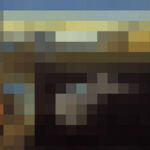


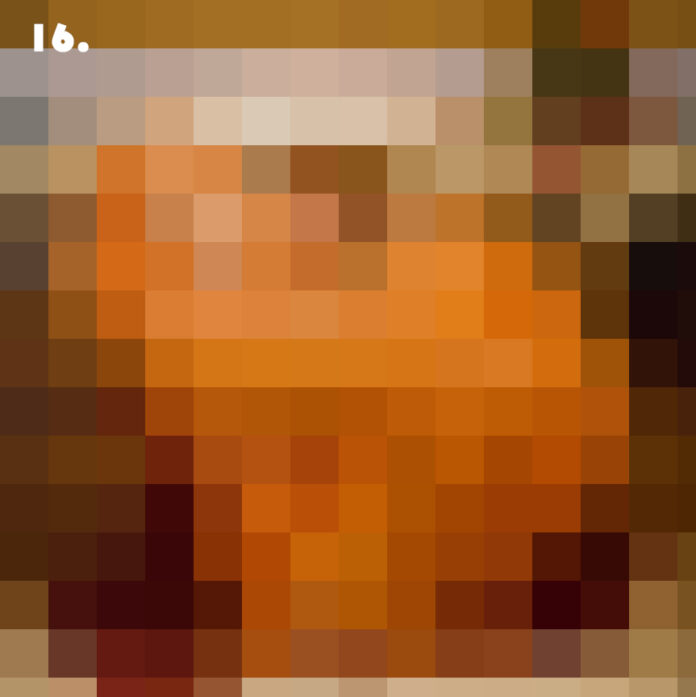




Stumped? Take a peek here:
Reveal the answer key
- Mona Lisa by Leonardo da Vinci
- Girl with a Pearl Earring by Johannes Vermeer
- Arrangement in Grey and Black No. 1, also known as Whistler’s Mother, by James McNeill Whistler
- Christina’s World by Andrew Wyeth
- American Gothic by Grant Wood
- Self-Portrait by Rembrandt Harmenszoon van Rijn
- The Arnolfini Portrait, also known as The Arnolfini Wedding, The Arnolfini Marriage, or Giovanni Arnolfini and His Wife, by Jan van Eyck
- The Scream by Edvard Munch
- The Son of Man by René Magritte
- The Last Supper by Leonardo da Vinci
- The Great Wave off Kanagawa by Hokusai
- The Birth of Venus by Sandro Botticelli
- The Persistence of Memory by Salvador Dalí
- Portrait of Madame X by John Singer Sargent
- The Starry Night by Vincent van Gogh
- Flaming June by Sir Frederic Leighton
- The Kiss by Gustav Klimt
- Washington Crossing the Delaware by Emanuel Leutze
- A Sunday Afternoon on the Island of La Grande Jatte by Georges Seurat
- Guernica by Pablo Picasso
