


Global diversity is often framed as a matter of exposure. Travel more. Read widely. Study other histories, languages, and traditions. Broaden your understanding of the world. This advice is valuable. But it assumes something rarely examined: that we already see clearly.
ÀNI Art Academies define global diversity as fostering cultural understanding, social responsibility, and meaningful engagement with the global community. That goal requires more than just a gathering of information; it requires examining how perception shapes interpretation. To engage across cultures, we need both a map and a mirror. The map expands knowledge of the world while the mirror helps us recognize the assumptions we bring to that knowledge. Without the mirror, the map can be misleading.
This pattern appears throughout art history. In the sixteenth century, Giorgio Vasari documented artistic achievement in his Lives of the Artists. His project broadened awareness of Renaissance art, but it also reflected Florentine priorities and a belief in artistic progress culminating in Michelangelo. His framework shaped artistic judgment for centuries. The works themselves were not neutral, nor was the interpretation surrounding them. The lesson is straightforward: knowledge alone does not produce understanding. We must also examine the lens through which knowledge is organized.
The Map: Expanding Vision
A map widens awareness. In art education, this means looking beyond the parameters of isolated canons and recognizing that ideas about beauty and value are shaped by context. New contextual experiences, such as encounters between cultures, often reshape artistic perception. When European artists encountered African sculpture and Japanese prints in the late nineteenth century, they did not simply add new objects to their collections. They confronted unfamiliar approaches to form, space, and abstraction. These encounters disrupted habitual ways of seeing. Picasso’s early Cubist breakthroughs drew on multiple sources—including Iberian forms and African objects encountered in Paris—though scholars debate the degree and mediation of these influences. Edgar Degas and Vincent van Gogh absorbed compositional ideas from Japanese ukiyo-e prints. Cropping became bolder. Outlines became clearer. Space became more dynamic. The map expanded, and perception shifted with it.
Linear Perspective offers a similar example. The system described by Leon Battista Alberti organized space according to mathematical logic. Over time, linear perspective in Europe was often treated as a privileged convention for pictorial realism and objectivity—powerful, but historically situated rather than universal. Other traditions approached pictorial space differently. Many Chinese landscape scrolls guide the viewer through multiple viewpoints over time. These approaches reflect different assumptions about how experience unfolds.

Vision science reinforces this point. Researchers such as Hermann von Helmholtz argued that perception involves unconscious inference. Later work by Stephen Palmer and others shows that the brain builds visual experience from incomplete data, using expectation and memory to stabilise the world. Biology sets constraints, but experience refines interpretation. This means that we do not passively see. Rather, we actively construct and interpret.
Realism as Training
Visual demonstrations, often called “optical illusions,” reveal how this process works. In the Müller-Lyer illusion, equal lines appear different because the brain applies depth assumptions. Even after measurement, the illusion persists. The system continues to rely on learned shortcuts.
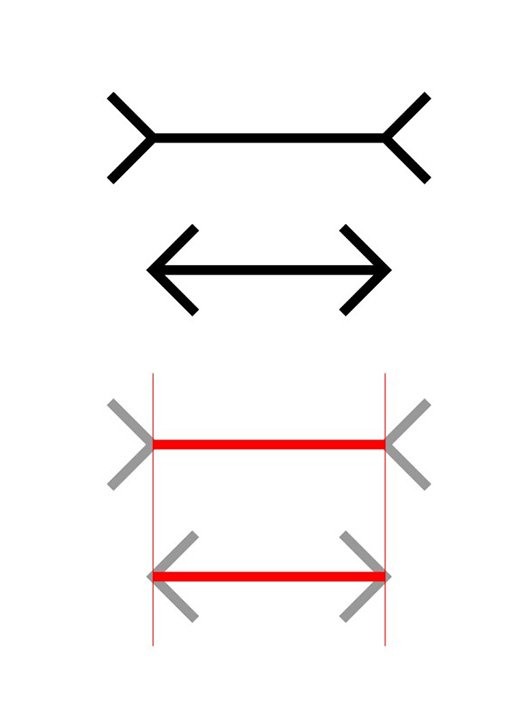
Artists have long used this knowledge. Baroque ceiling paintings dissolve architecture into the sky by guiding expectation. Trompe l’oeil persuades because perception fills in what it expects. Realism, then, is not colloquial “copying”; It is skilled interpretation and construction.
The contrast between Byzantine icons and High Renaissance naturalism clarifies the point. Icons emphasise symbolic clarity rather than optical accuracy. Their goal is spiritual communication. Naturalism pursues spatial coherence and material presence. Each system trains attention differently.
Traditional atelier training makes this explicit. Beginners draw symbols. Instruction shifts attention toward measurement, proportion, and relational seeing. Ingres is often credited with calling drawing “the probity of art,” because it demands honesty about what is observed rather than what is assumed. Accurate perception develops through guided correction. Global understanding follows a similar path. Exposure is necessary, and calibration is essential.
Culture Through a Lens
Cultural misunderstanding is often treated as a lack of information. Yet, as we’ve seen earlier here, information alone may not reshape interpretation in any significant way. Nineteenth-century Orientalist painting illustrates the risk. Jean-Léon Gérôme produced highly detailed images of North Africa and the Middle East. Many appear documentary. Yet they often staged imagined scenes shaped by European expectations. The artists gathered visual data but did not question their interpretive frameworks. The map expanded. The mirror remained untouched.
Psychological research supports this pattern. Frederic Bartlett demonstrated that memory is reconstructive. Ulric Neisser showed that perception relies on schemas that guide attention. Mahzarin Banaji and Anthony Greenwald revealed how implicit biases influence judgment outside conscious awareness. Efficiency helps the mind function, but it can also reinforce error. Cross-cultural studies by Richard Nisbett suggest that environments shape attention. Some contexts emphasise focal objects while others emphasise relationships and context. The underlying visual system is shared, but training directs awareness.
Art reflects these differences. European still life often isolates objects in a controlled space. Chinese landscape traditions integrate elements into an atmospheric whole. One approach separates. The other connects. Neither is biologically predetermined.

Objects are isolated within a controlled field. Light, edge, and spatial containment direct attention toward discrete forms. The composition encourages focused inspection of individual elements.

Forms unfold within an atmospheric continuum. Mountains, water, and human presence are integrated into a relational whole. Attention moves across intervals rather than resting on a single focal object. These compositional differences can be read as compatible with documented cultural tendencies in attention (analytic vs holistic), while remaining shaped by genre, patronage, and local artistic theory. The visual system is shared. Cultural practice directs awareness.
Global diversity, therefore, involves differences in interpretation as much as differences in custom.
The Mirror: Discipline and Humility
The mirror is not self-absorption; it is discipline. Drawing from observation teaches that first impressions may be unreliable. Students measure, compare, and revise. Successful representation and productive perception, both, often require correction.
Art history offers parallel examples. The Impressionists responded to new discussions of optics and colour. Paul Cézanne questioned fixed perspective and treated vision as constructed over time. Each shift required viewers to reconsider what seeing meant. Global engagement requires similar humility. While our interpretations may be informed, they remain provisional. Without inward calibration, knowledge becomes mere surface familiarity. Cultural details accumulate while interpretive habits remain unchanged. History provides warnings. Colonial exhibitions presented artefacts as symbols of educational progress while reinforcing hierarchies. Knowledge without reflexivity became a tool of dominance.
The alternative is integration. Outward exploration guided by inward discipline. Global diversity is not passive exposure. It is the ongoing refinement of perception. Like drawing, it improves with practice.
Resources
- Greenwald, A. G., & Banaji, M. R. (2017). The implicit revolution: Reconceiving the relation between conscious and unconscious. American Psychologist.
- Rubin, P. L., & Rubin, M. (1995). Giorgio Vasari: Art and History. Yale University Press
- Biow, D. (2018). Vasari’s Words: The “Lives of the Artists” as a History of Ideas in the Italian Renaissance. Cambridge University Press
- Maiorino, G. (1976). Linear Perspective and Symbolic Form: Humanistic Theory and Practice in the Work of L. B. Alberti. The Journal of Aesthetics and Art Criticism.
- Mitrović, B. (2004). Leon Battista Alberti and the Homogeneity of Space. Journal of the Society of Architectural Historians.
- Edgerton, S. Y. (2009). The Mirror, the Window, and the Telescope: How Renaissance Linear Perspective Changed Our Vision of the Universe. Cornell University Press (via Google Books).
- Nochlin, L. (2006). The Imaginary Orient. In Visual Culture: Spaces of Visual Culture. (Gérôme and “documentary realism” critique.)
- Chave, A. C. (1994). New Encounters with Les Demoiselles d’Avignon: Gender, Race, and the Origins of Cubism. The Art Bulletin.
- Gikandi, S. (2003). Picasso, Africa, and the Schemata of Difference. Modernism/modernity.
- McCausland, S. (2023). The Art of the Chinese Picture-Scroll. Reaktion Books.
- Kindall, E. (2012). Experiential Readings and the Grand View: Mount Jizu by Huang Xiangjian. The Art Bulletin.
- Coombes, A. E. (1994). Reinventing Africa: Museums, Material Culture, and Popular Imagination in Late Victorian and Edwardian England. Yale University Press.
