

Most people tend to think of an artwork as a relatively stable object: paper, paint, canvas, panel, frame. The reality, though, is that many artworks are dynamic, more akin to small weather systems. They are constantly exchanging moisture, heat, and stress with the surrounding air. This is especially true for traditional materials such as paper, canvas, wood, hide glue, starch paste, hardboard, and many grounds and adhesives. These materials are hygroscopic, meaning they absorb and release water vapor from the surrounding air. They do not need to be visibly wet to be changing. They can swell, shrink, soften, tighten, slacken, cockle, warp, or crack simply because the surrounding relative humidity changes. The Canadian Conservation Institute notes that hygroscopic materials such as wood, paper, and fabric release moisture and contract at low RH levels, while RH-related movement can cause distortions in paintings and supports.
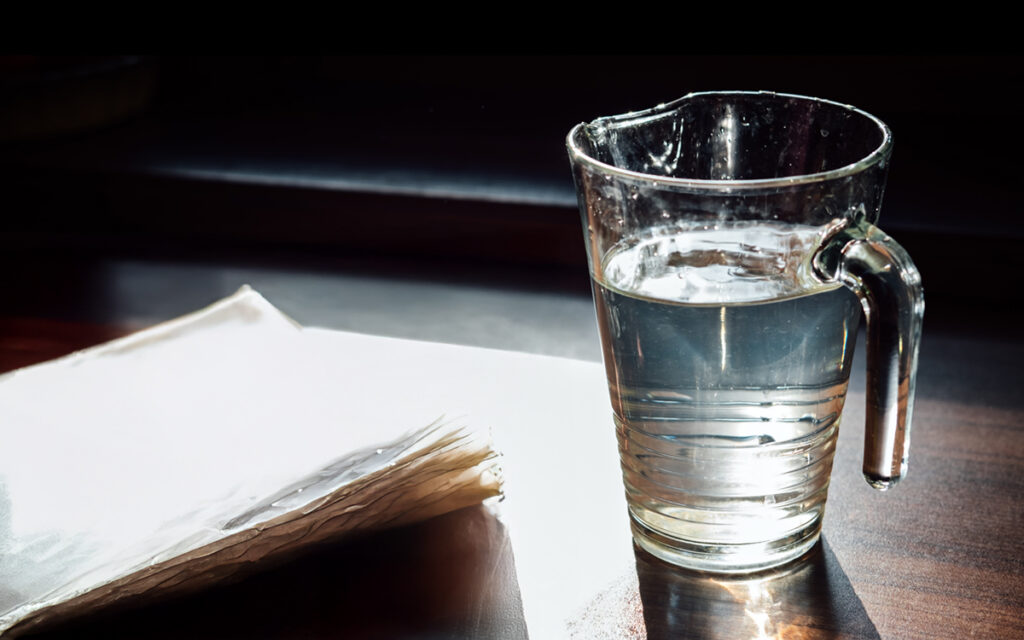
In my experience, navigating these concerns is most successful when you develop a good understanding of the factors at play. One way I explain the applicable dynamics of temperature and relative humidity is the water jug metaphor. It goes like this:
Relative humidity, or RH, compares how much water vapor is actually in the air with how much water vapor could remain in the air at that temperature before condensation begins. Think of temperature as changing the size of an invisible jug for water vapor. When the temperature rises, the jug expands. When the temperature goes down, the jug gets smaller. The actual amount of water vapor in the room may stay the same, but the size of the jug changes, which means the relative humidity changes.
For example, imagine the jug can hold 10 gallons of water vapor, and there is 1 gallon of water vapor present. The jug has only a fairly small amount of water relative to the container, so we can say that the relative humidity is low. Now imagine warming the room. The amount of water vapor has not changed, but the jug has become larger. Since the same amount of vapor now fills a smaller fraction of the jug, the relative humidity drops.
Now, imagine cooling the room. The amount of water vapor has not changed, but the jug has become smaller. The same amount of vapor now fills a larger fraction of the jug, so the relative humidity rises. The air has effectively become more moisture-rich, making that moisture “more available” to hygroscopic materials. Paper fibers may swell, canvas may slacken, adhesives may soften, and hardboard or wood-based panels may expand or warp. If the room cools enough, the jug becomes too small for all the water to remain as vapor, and the excess moisture condenses as liquid water on nearby surfaces. This is especially dangerous for artworks because liquid water can cause staining, mold, swelling, distortion, and adhesion failure.
This is the subtlety that is really important to grasp here: Moisture content may seem like the primary concern because it indicates how much water vapor is present. However, for hygroscopic artwork materials, relative humidity is often the more pressing concern because it tells us how “full” the air is relative to its capacity at that temperature. That fullness determines whether the air behaves as drying, balanced, or moisture-rich. When RH is low, the air has more capacity to take moisture from paper, canvas, wood, or hardboard. When RH is high, the air is closer to saturation, and those materials are more likely to retain or absorb moisture. In other words, RH tells us how likely moisture is to move between the air and surfaces as they seek equilibrium.
What “Hygroscopic” Really Means
To say that paper, canvas, or hardboard is hygroscopic is not simply to say that “humidity affects it.” It means that the material participates in an exchange with the surrounding air. When relative humidity rises, hygroscopic materials take up moisture. When relative humidity falls, they release it. These changes can alter their dimensions and mechanical properties: paper and wood-based boards may swell, soften, cockle, or distort; at low RH, they may shrink, stiffen, or become more brittle. Canvas is more complex because swelling fibers can cause a woven fabric to tighten or shrink.
So again:
When RH rises, hygroscopic materials absorb moisture.
When RH falls, they release moisture.
When they absorb moisture, they often expand or soften.
When they release moisture, they often shrink, stiffen, or become more brittle.
This creates a pathway to stress because artworks are rarely made from a single material. A painting may include canvas, ground, oil or acrylic paint, varnish, stretcher bars, metal fasteners, labels, adhesives, and a frame. Each material responds to moisture at a different rate and to a different extent. One layer may expand while another resists; one side of a panel may dry faster than the other; one face may be sealed with paint while the reverse remains exposed; and thus an object is pulled into internal conflict (resulting in what we often describe generally as “warping”).
The Conservation Center for Art & Historic Artifacts describes this pattern clearly: high RH can promote swelling, distortion, and biological risk (including mold growth, pest activity, and microbial deterioration); low RH can embrittle paper and contribute to cracking; and large RH swings are especially damaging to composite objects because their components swell, shrink, stiffen, or relax at different rates.
Paper: The Sensitive Sponge
Paper is one of the clearest examples of a hygroscopic material. Made largely from plant-derived cellulose fibers, it readily takes up and releases moisture from the surrounding air. But paper is not a single, uniform material. Paper type and manufacture matter: rag paper, wood-pulp paper, tracing paper, coated paper, and newsprint age differently and respond differently to moisture. Acidic wood-pulp papers, for example, are generally more prone to embrittlement.
Sizing and coatings matter too. Gelatin, starch, alum-rosin sizing, clay coatings, and other surface treatments can change how quickly paper absorbs moisture, how much it swells, and how media sit on or within the surface.
At high relative humidity, paper can swell, cockle (forming small waves, puckers, or uneven ripples across the sheet), ripple, distort, and become more vulnerable to mold. Adhesives may soften, and water-sensitive or friable media (powdery, crumbly, or easily dislodged from the surface) may become less stable, especially when the sheet is acidic, degraded, previously damaged, or poorly supported.
Restraint also matters when it comes to paper. Hinges, mats, dry mounts, tapes, linings, and adhesives can prevent the sheet from moving freely. When paper expands and contracts but cannot move evenly, ordinary dimensional change can become cockling, tearing, delamination, or planar distortion. Even when paper is mounted, as in dry-mounting, the resulting structure is not immune to stress: the paper is joined to an adhesive layer and support board, which may introduce new stresses if the layers respond differently to humidity.
It’s also important to note that at low RH, paper can become stiff, brittle, and more prone to cracking or tearing. With repeated RH cycling, the sheet expands and contracts repeatedly, like a hinge flexed until it weakens.
Canvas: A Moving Support under Tension
Canvas is also hygroscopic, but it behaves differently from paper because it is woven and usually held under tension. Changes in relative humidity can cause canvas to tighten, slacken, ripple, distort, or transfer stress to the paint and ground layers. This movement is not always straightforward: as fibers absorb moisture, a woven fabric may change shape within the weave, sometimes tightening or shrinking rather than simply expanding.
A canvas painting is not one sheet behaving uniformly. It is a layered structure: fabric, size, ground, paint, varnish, stretcher, and sometimes linings, patches, keys, labels, or backing boards. When RH changes, these layers do not all move together. The support may relax while the paint film remains more rigid, or the canvas may move enough to place stress on brittle paint. Older paintings can be especially vulnerable when paint, ground, or adhesive layers have become stiff, cracked, cupped, or poorly attached.
Over time, repeated movement can contribute to cracking, flaking, delamination, planar distortions, corner draws, slackness, and other tension problems. The stretcher or strainer also matters: a rigid, warped, keyed-out, or poorly fitting support can concentrate stress rather than distribute it evenly.
Research on canvas paintings shows that back protection can help stabilize RH behind a painting, reducing the effects of environmental variation on the support. A backing board or other protective system can slow moisture exchange, buffer the painting from drafts and rapid RH shifts, and reduce dust and mechanical vulnerability, though it cannot make the object immune to poor environmental conditions.
Hardboard Panels: Stable-looking, but also Moisture-Reactive
Hardboard, while rigid and seemingly dependable in this arena, is still a wood-fiber product. It absorbs and releases moisture, especially at exposed edges, damaged areas, and unsealed backs. Edges are often the weak point: if they are exposed, abraded, or poorly sealed, they can take up moisture faster than the faces and become sites of swelling or distortion. Because hardboard is dense and panel-like, moisture movement can show up as bowing, cupping, edge swelling, surface stress, layer separation, or movement between the support and the paint or ground layers.
Hardboard is particularly vulnerable when one face is sealed or less permeable, and the other is not. If the painted front responds differently from the exposed reverse, the panel can curve. This is similar to what happens with wood-panel paintings, where unequal moisture exchange between the front and back can cause distortion. The Canadian Conservation Institute (CCI) notes that when one face of a support is covered with design layers, and the reverse is exposed, the two sides can absorb and release moisture differently, causing curvature or deformation.
This pattern is consistent with conservation guidance on wood and wood-fiber supports: moisture need not affect the entire panel evenly to cause damage. When one area or face responds differently from another, the result can be curvature, surface stress, coating failure, or distortion.
ACM: Less Hygroscopic, but not Immune
Aluminum composite material, or ACM, is quite a bit different. Unlike paper, canvas, wood, or hardboard, ACM itself is not strongly hygroscopic. ACM panels used as art supports are typically sandwich panels: thin aluminum skins bonded to a plastic or mineral core. This structure makes them dimensionally stable in ways that traditional organic supports are not. ACM is widely valued because it is smooth, rigid, lightweight, and relatively moisture-resistant compared with wood-based panels.
But ACM does not make an artwork immune to environmental stress. Aluminum expands and contracts with temperature, and the ground, paint, adhesive, fabric interleaf, or mounted paper attached to ACM may still be hygroscopic. The artwork also becomes a composite system: even if the panel itself remains stable in humidity, the layers attached to it may not. That mismatch can create stress at the interface between the ACM and the prepared surface.
Surface preparation is also worth considering. Because ACM is relatively non-absorbent, grounds, paints, adhesives, or interleaf layers rely on appropriate mechanical or chemical adhesion. If the surface is poorly prepared or if attached layers expand, contract, stiffen, or soften differently from the panel, environmental changes can contribute to lifting, cleavage, cracking, or delamination.
So while it is true that ACM can significantly reduce certain risks in this context, especially moisture-driven warping associated with wood and hardboard, it does not eliminate the need for stable temperature and RH. It just changes the risk profile: the support may be more dimensionally stable, but the artwork is still a layered system whose weakest point may be the bond between materials.
Temperature: the Accelerator
Temperature matters here in two main ways.
First, as we’ve discussed at the onset here, temperature affects relative humidity. If the amount of moisture in the air stays the same but the room cools, RH rises. If the room warms, RH falls. This means temperature swings can create RH swings even without adding or removing moisture from the room.
Second, it’s important to note that heat accelerates deterioration. Many chemical reactions happen faster at higher temperatures. The Northeast Document Conservation Center (NEDCC) notes that the rates of many chemical reactions roughly double for each 18°F/10 °C increase in temperature, which is why cooler temperatures are generally preferred for collections with long-term value.
For artwork, heat can accelerate yellowing, embrittlement, adhesive failure, oxidation, potential off-gassing, and degradation of paper, canvas, wood products, plastics, coatings, and varnishes. Heat combined with high RH is especially concerning because it creates favorable conditions for mold growth and other biological activity.
Humidity: the Mover
Humidity is the great mover of organic materials. By this point, the pattern should be clear: humidity is often the force that puts materials into motion. The important point is not simply that high or low RH can be harmful, but that humidity affects different parts of an artwork in different ways.
Fluctuation is its own risk. Repeated RH cycling can fatigue already-weakened materials, enlarge existing cracks, loosen brittle paint, stress adhesive joints, worsen planar distortion, and impose repeated strain on supports, grounds, paints, mounts, and frames. In many cases, a stable but slightly imperfect RH is less damaging than frequent movement between extremes.
Damp conditions create a different category of risk. The Canadian Conservation Institute identifies incorrect RH as a major agent of deterioration and treats conditions around or above 75% RH as a serious concern for collections. At these levels, moisture can promote mold, corrosion, staining, adhesive failure, distortion, and other forms of damage.
So the goal is not to find a magical RH number that makes every material safe. The goal is to avoid extremes, prevent damp conditions (often treated in conservation guidance as sustained RH around or above 75%), and reduce unnecessary swings so that the object is not repeatedly forced to adjust.
Barometric Pressure: Potentially Relevant
In a recent discussion on this, one of my colleagues mentioned barometric pressure. Barometric pressure is less often discussed than temperature and RH because, in normal gallery and storage settings, it usually affects artworks indirectly. Pressure changes often accompany weather systems: storms, wind, rain, humid air, leaks, and shifts in building airflow. In that sense, a falling barometer is less a direct threat to an artwork than a warning that indoor conditions may become less stable.
Pressure can become far more relevant in sealed or semi-sealed systems, such as packages, crates, storage boxes, and display cases. These enclosures are designed to slow air exchange and buffer vulnerable works from ambient RH fluctuations, pollutants, dust, insects, and water events. But when external pressure changes, especially during transport, altitude change, air travel, storms, or rapid weather shifts, the enclosure may “breathe” through small gaps or experience pressure differences across seals, glazing, or flexible materials.
For most everyday collections, barometric pressure is far less important than RH and temperature. But it becomes worth considering when an artwork is tightly enclosed, transported, flown, moved between elevations, or exposed to severe weather. In those cases, pressure is part of the larger environmental picture: not usually the main cause of damage, but one factor that can influence air exchange, enclosure performance, and moisture risk.
The Real Enemy: Fluctuation
The central preservation issue is not simply “hot,” “cold,” “wet,” or “dry.” It is movement.
An artwork can often tolerate a “less-than-perfect” environment if that environment is stable and not extreme. The greater risk comes from repeated daily or seasonal swings, which force different materials to adjust again and again, often at different rates. Paper may distort and relax; canvas may tighten or slacken while transferring stress to paint; hardboard may bow and partially recover, only to move again with the next shift. Paint, ground, and adhesive layers may resist, soften, stiffen, creep, crack, lift, or fail as they are pulled through these cycles. Metal components expand and contract with temperature, and even ACM, though relatively stable in response to moisture, can still respond to temperature while the layers attached to it move differently.
The artwork becomes a small battleground of varying expansion rates, moisture responses, and stress tolerances. That is why preservation is not just about reaching an ideal number. It is about avoiding extremes as well as the severity, frequency, and speed of environmental changes. Stable conditions buy time while fluctuations spend it.
A Better Way to Think about Preservation
The goal is not to make the air simply “dry.”
The goal is not to make the room simply “cold.”
The goal is to create a stable environment where materials are not constantly being asked to move, soften, stiffen, expand, contract, or re-equilibrate.
For mixed artwork collections, moderate and stable conditions are usually safer than aggressive correction. A sudden attempt to “fix” the environment can sometimes create the very stress one is trying to avoid. Monitoring temperature, RH, and dew point is essential because a single reading does not tell the whole story. The daily highs and lows, the duration of an unsafe condition, and the rate of change all matter. CCAHA (the Conservation Center for Art & Historic Artifacts, a nonprofit conservation organization that provides preservation guidance for libraries, archives, museums, and collecting institutions) recommends monitoring temperature, relative humidity, and dew point as basic indicators for understanding collection environments.
A useful preservation formula might be:
Risk = severity × duration × fluctuation
A brief RH spike may be manageable. A sustained high-RH period is more dangerous. A repeated daily swing may be more damaging than either number alone because it forces materials through cycles of adjustment again and again.
In Closing…
The air around an artwork is not empty. It is a dynamic climate acting on every layer and component of it.
Temperature changes the size of our “invisible jug”; moisture fills it, and relative humidity tells us how full that jug is relative to its capacity. As those conditions shift, the materials that carry our creative expressions respond in different and sometimes conflicting ways: swelling and shrinking, softening and stiffening, expanding and contracting, tightening and slackening, absorbing stress and releasing it. Traditional materials such as paper, canvas, and hardboard are especially vulnerable because they are hygroscopic, whereas newer supports such as ACM can reduce certain forms of movement, particularly moisture-driven panel distortion. But even ACM does not entirely remove environmental risk, because the artwork remains a layered system.
Remember, the preservation goal is not perfection; it is extreme-free stability. A stable environment lets the artwork rest. A fluctuating environment keeps asking it to breathe, bend, swell, shrink, and fight itself. And that is where damage begins.
